A star-lit northwoods
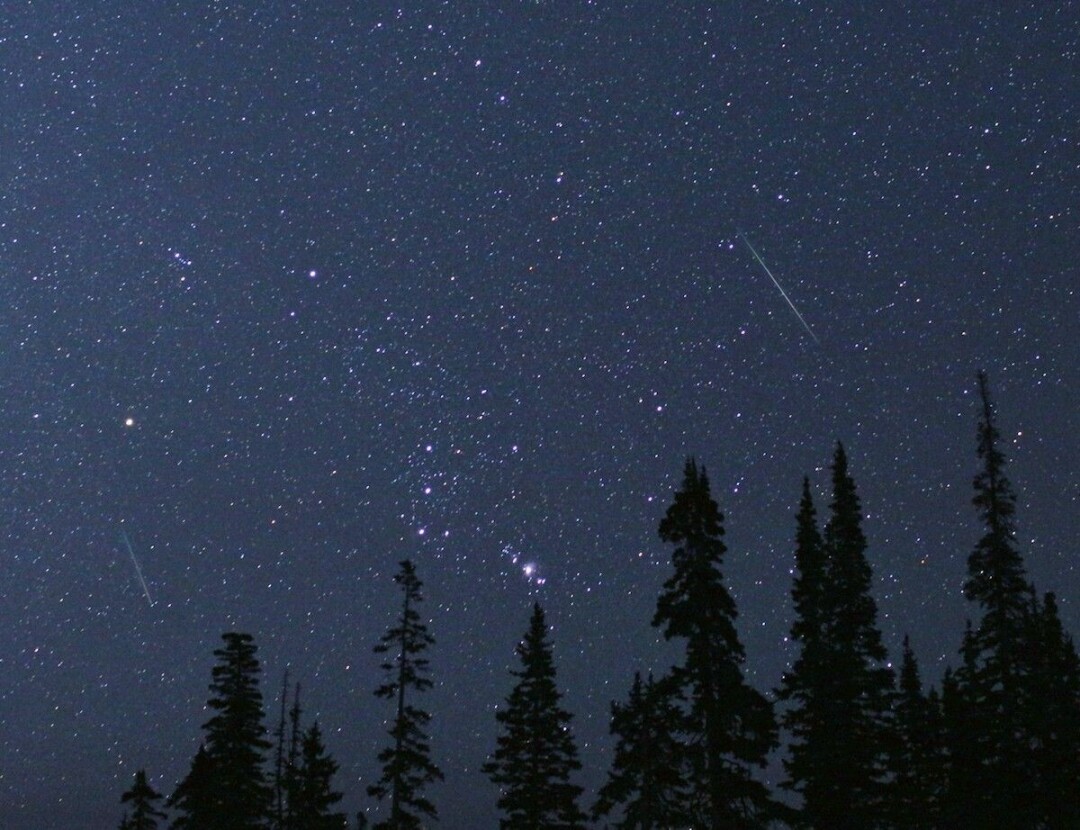
An abundance of stars over a conifer forest. Photo by NASA.
Headlights cut through inky darkness as we slowly pulled into the parking lot. The intensity of the dark was daunting.
We stared out into the seemingly endless void for a few seconds, taking in the magnitude of it. At any moment, it seemed as though it would overpower my headlights, leaving us in complete darkness. But we gathered up our courage, shut off the car, and gathered our supplies.
We had stars to watch, and they were beckoning us into the night.
November is a chilly time to stargaze in the northwoods, but can provide a few advantages to the experience. The nights are darker earlier and the lower humidity levels mean less atmospheric haze, resulting in a sharper view of the stars.
As a bonus, you can bring a warm drink to keep away the chill.
Though the stars were visible immediately, it took our eyes a while to fully adjust to the dark, allowing us to see the dimmer stars in the sky.
The Chequamegon-Nicolet National Forest is a Class II Dark Sky Site. This means that, under the right conditions, the Milky Way, meteors and nebulae are visible to the naked eye. This is all due to low urban development and dark sky stewardship efforts over multiple decades.
Even after living here for nearly two years, I am still blown away at how dark the northwoods are at night.
After laying on the ground for some time, thousands upon thousands of glittering stars lit up our little section of sky, ranging in size, color and brightness.
It’s amazing to me that each star hanging high in the sky was formed from a molecular cloud made of gas and dust. The cold temperature of the molecular cloud makes the dust clump up, creating a high density pocket in space.
Eventually, gravity causes the clump to collapse. Friction from the collapse creates heat, and produces a baby star, also known as a proto star.
After millions of years of immense pressure and high temperatures in the protostar’s core, the nuclei of hydrogen atoms are squeezed together to form helium, in a process called nuclear fusion. This releases enough energy to heat the star even more, and keeps the “adult” star from collapsing.
The light from these stars can take anywhere from 8 minutes to reach us–like with the Sun’s light - or up to billions of years. It all depends on how close the stars are to the Earth.
Light travels at roughly 186,282 miles per second. On a larger scale, a light-year is the distance light can travel in a year, and is relatively 6 trillion miles.
To put that distance into perspective, Alpha Centauri is the closest star system to our solar system, and it is around 4.3 light years away. That’s roughly 25 trillion miles from Earth.
Stars in the Milky Way Galaxy can be up to 100,000 light years away. Outside of our galaxy, stars can be billions of light years away.
These stars that we see in the night sky are millions to billions of years old, scientists think some are as old as the universe itself.
They existed before us, and were there as the Earth and its inhabitants changed millions of times. They guided early peoples through the night, the changing of seasons, and connected us all through constellations and stories.
When we gaze into the night sky, we are seeing the same stars our ancestors, and their predecessors gazed at before them.
What a privilege it is, to walk this beautiful Earth, and be connected to those before us through the stars.
Heaven Walker is Educator/Naturalist at the Cable Natural History Museum. For more than 50 years, the Cable Natural History Museum has served to connect you to the northwoods. The museum’s new exhibit, The Wetland Way is now open! Discover how life thrives at the intersection of soil and water, and why we must care for these special places as they care for us. Follow us on Facebook, Instagram, YouTube, and cablemuseum.org to see what we are up to.