Small things in a big world
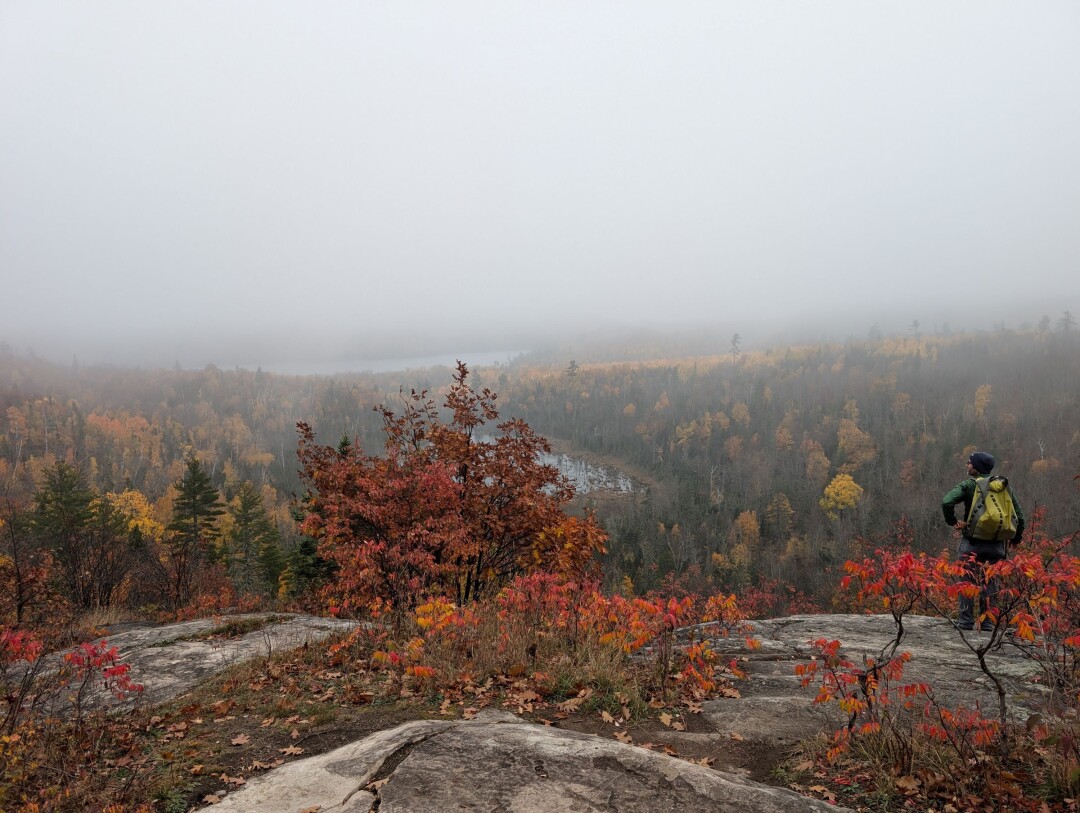
There are about as many species on Earth as droplets in this bank of fog. Photos by Emily Stone.
Fog has a way of bringing small things into focus. With heavy mist shrouding the treetops and vistas on a recent hike in Tettegouche State Park in Minnesota, my attention settled on the plants and their parasites senescing along the trail.
A knee-high stem of round-leaved dogwood waved just a few pairs of solar panels, their once-vivid greens fading to pale pink and buttery yellow.
On one, a leaf miner had inscribed the meandering progress of its hungry childhood. The larva spent a few weeks tunneling between the layers of the leaf and feeding on chlorophyll soup. The resulting frass (caterpillar poop) darkened the tunnel clear up to the widest end.
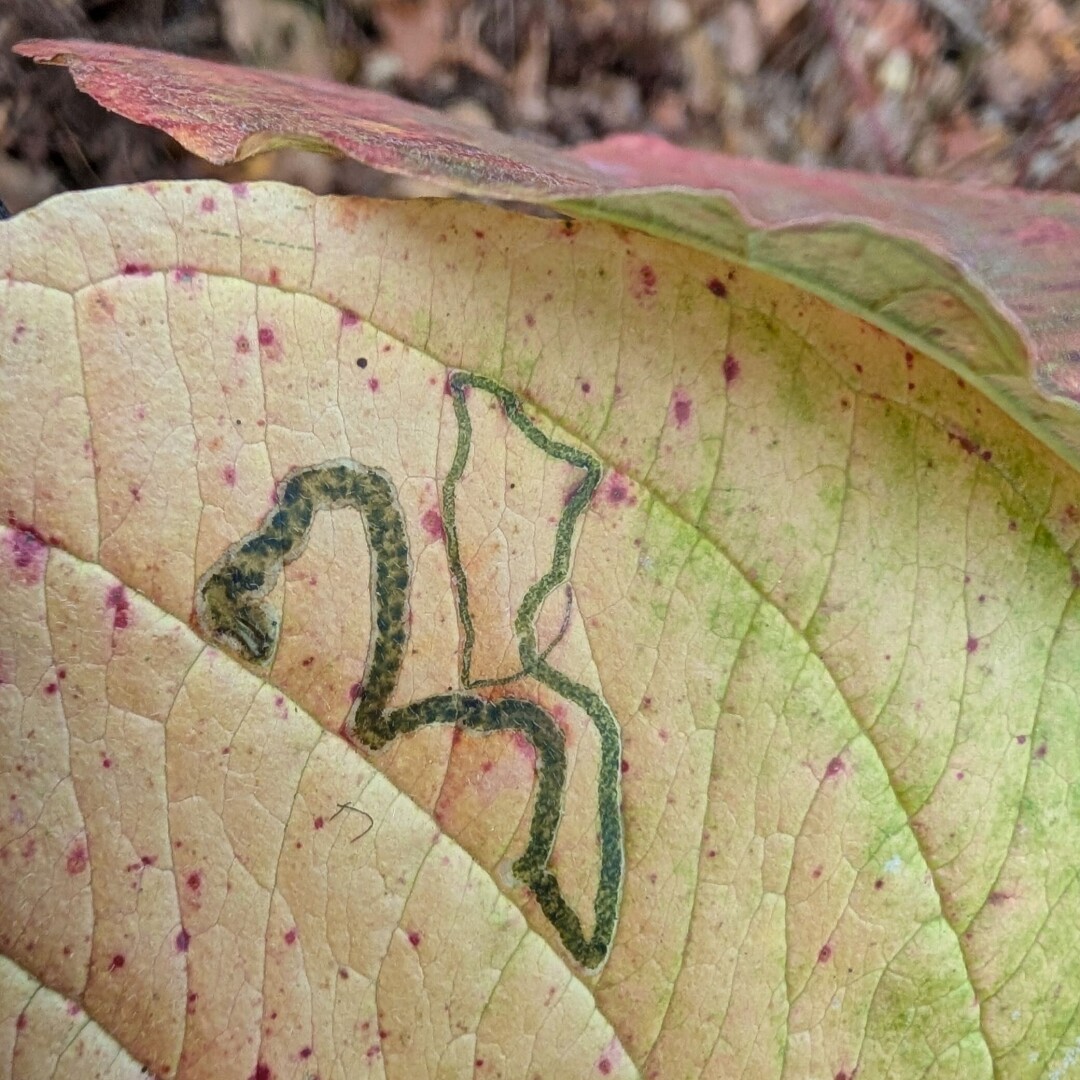 The Dogwood Leaf-mining Fly made this squiggly leaf mine in a senescing dogwood leaf. Like many insects, they are closely tied to their host. This host specificity translates into species incredible diversity!
According to iNaturalist, the excavating insect is the “dogwood leaf-mining fly.”
Below the dogwood, the heart-shaped leaf of a still-green large-leaved aster bore the squiggly scrapbook of an “aster tentiform blotchminer.”
In this case, the tiny larva who fed between the layers started out with a flattened head and body and squeezed into a narrow mine that spiraled around the leaf. As it grew, shed its exoskeleton and entered later developmental stages known as instars, the larva’s body became cylindrical and it opened up a big hollow tent in the leaf tissue. Next spring it will metamorphose into a delicate moth.
In the same patch, a yellowing aster leaf stood out against the brown duff. Although it was well on its way to decomposition, leaf mines radiating from the center midrib were still quite visible. This is the most common leaf mine I see on the asters, but the minuscule moth larva who makes it still doesn’t have a common name.
Despite all of these distractions, we finally made it to the top of the trail. Scarlet plumes of staghorn sumac in full fall color glowed in the foreground. Beyond that, fog faded the yellows of late-season aspen leaves toward an abrupt end at a wall of gray mist.
Looking down, I found a little patch of sumac with clusters of mangled leaves at their tips, like small pink Medusas. Just like leaves we’d seen on the way up, I knew some little invertebrate was responsible for the deformation.
Once again, I asked iNaturalist for help with identification. Eriophyes rhoinus was the only name given — an Eriophyid mite. They are part of a large group of tiny arachnids who each specialize in forming galls on a particular species or genus of plants. Even though you need 40x magnification to see the cigar-shaped, two-legged mites, thousands of species have been described. But because of their specialization, scientists think that this is only a fraction of the actual number of species in the group.
Beetles are famous for being similarly diverse. Scientist J. B. S. Haldane wrote that “The Creator would appear as endowed with a passion for stars, on the one hand, and for beetles on the other…”
But these numbers are in part due to the beetle collecting fad that began in the 1800s, which perhaps was one of the first examples of community members helping scientists to record biodiversity. Almost any group of insects who developed such a fan club would likely prove to be just as diverse.
That’s particularly true of parasitic or parasitoid insects — like the leaf miners I spotted on my hike — who are closely tied to their hosts. Since each plant and each beetle (and pretty much every organism) has at least one or two parasites who feed on them, the diversity of parasites must be astronomical.
For example, scientists have described about 100,000 species of parasitic wasps, but some researchers have also estimated that there are twelve times that number in existence — it’s just that no one has formally described them.
When you also consider that each of those wasps (and beetles, etc.) has a unique microbiome filled with mites, bacteria, viruses and fungi, the numbers become unfathomable.
When scientists provide estimates of the number of species on Earth that range from 3 million to 1 trillion, those numbers feel to me a little like the fog bank filled with similarly uncountable numbers of tiny water droplets.
When lives become numbers, it’s easier to lose site of the big picture: that the entire world is layered with life. Perhaps both the fog and the quest to count species make us focus on the individual who is close at hand — the wasp who is new to science, or the leaf miner along the path.
Scientists have said we can’t save a species from going extinct if we don’t know they exist. I’m not sure that’s true.
Every autumn I leave the leaves in my yard not because I know that a certain species is overwintering in them, but because I assume that an untold number of Beings need that shelter. Perhaps an
entomologist could identify each one. While fascinating, that likely wouldn’t change my practice.
If we take care of the species we do know exist; if we protect the full range of habitats and natural processes; if we move through the world believing that we are surrounded by lives that are worth allowing to continue; then it doesn’t really matter if we can see through the fog of numbers.
Emily Stone is Naturalist/Education Director at the Cable Natural History Museum. Her brand-new third book, Natural Connections3: A Web Endlessly Woven, is available to purchase at cablemuseum.org/books and at your local independent bookstore, too. For more than 50 years, the Cable Natural History Museum has served to connect you to the Northwoods. Our Summer Calendar is open for registration! The Museum’s new exhibit, The Wetland Way is now open! Discover how life thrives at the intersection of soil and water, and why we must care for these special places as they care for us. Follow us on Facebook, Instagram, YouTube, and cablemuseum.org to see what we are up to.