No mere bird
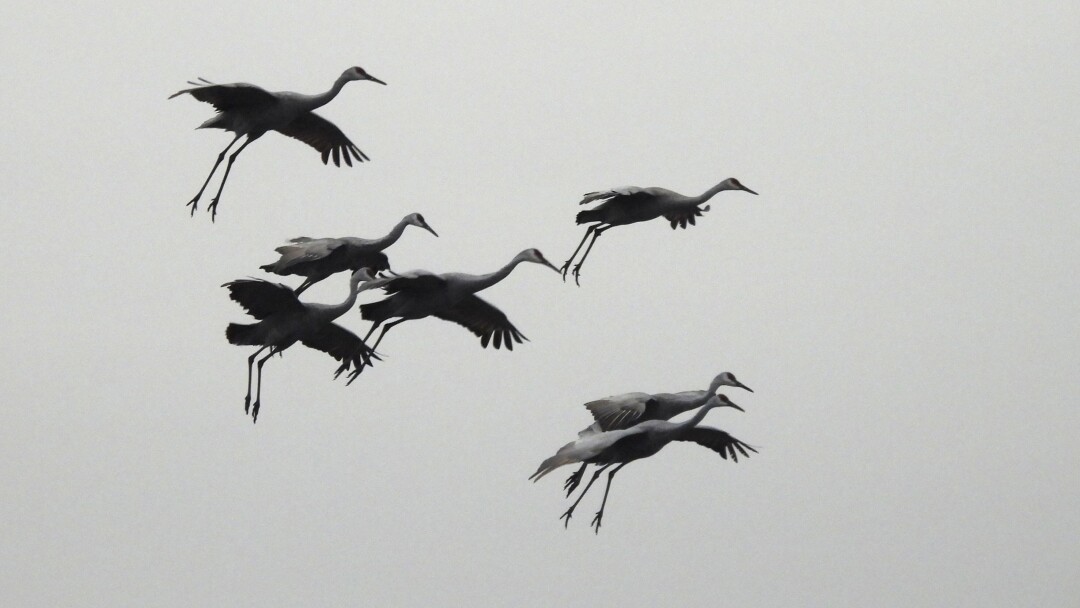
ll in alignment, the cranes shifted to cup their wings and dangle their
“Turn here, they’re heading north!” I directed my fiancé as we navigated the gravel roads of Crex Meadows Wildlife Area near Grantsburg, Wis.
We’d spotted a line of sandhill cranes flying through misty gray sky and were following them toward what we hoped would be a spectacular evening of birdwatching.
Despite living in a time when perhaps only 20 pairs of cranes existed in Wisconsin, Aldo Leopold wrote eloquently of the cranes in the “Marshland Elegy” chapter of A Sand County Almanac. “When we hear his call we hear no mere bird. We hear the trumpet in the orchestra of evolution. He is the symbol of our untamable past, of that incredible sweep of millennia…”
Today, thousands of sandhill cranes converge near just this one expertly managed and protected wetland complex during fall migration. They spend their days fueling up for migration by gleaning waste grain from recently harvested corn and soybean fields nearby.
Then, at dusk they rise from the fields and fly into the marsh, or at least that’s the plan.
With the extreme drought that plagued Northern Wisconsin this summer and fall, the wetlands where we’d watched the cranes land a year ago had been reduced to mudflats.
We heard a tip that the birds were hanging out near the deeper waters of Phantom Lake, so we paused on its southwest shore to have a look. Strident calls preceded a long line of cranes who appeared above the treetops, crossed the road as we swiveled our necks and then, to our disappointment, continued northeast.
With an eye toward other flocks streaming in the same direction, we puttered a few miles north on gravel roads to where we could see cranes losing altitude.
From their streamlined flight posture with beak to toes all in alignment, the cranes shifted to cup their wings and dangle their legs below. Whole groups of them floated by in a sight reminiscent of Mary Poppins arriving with her umbrella. At this slower speed, the cranes could maneuver precisely so as not to land on top of an earlier arrival. They joined hundreds of cranes already feeding, fidgeting and settling in for the night.
Among the harsh trumpeting calls of the adults, occasional high-pitched twitters had me puzzled. It wasn’t until I explored recordings of their calls on All About Birds that I realized these were the calls of juveniles.
Unlike loons, cranes migrate and spend all winter with their mate and most recent offspring.
A few days after our visit, the Wisconsin DNR conducted the annual survey of the crane population. Staff and volunteers spread out among known roost locations in Crex and the nearby Fish Lake Wildlife Area.
Arriving before dawn, they prepared to witness the early morning commute of cranes from their bedrooms back to their breakfast fields. Last year, heavy fog reduced visibility and only 7,754 cranes were counted. This year, the crew saw 10,438 of these majestic birds — much more in line with their usual expectations.
A normal count wasn’t a sure thing this year, because of the extreme drought.
Patrick, the naturalist for Friends of Crex, told me they’d been worried the weather would have a negative impact on both crane visitors and human visitors to Crex, but that it turned out to be a good season. And recent rains might be helping.
“Wet weather has completely changed the landscape of Crex in just a few days,” he reported.
Weather may not have impacted their numbers, but it is a big factor in cranes’ migration schedule. Cranes migrate in response to food and temperature, with frozen wetlands or snow-covered fields pushing them south to find food and shelter.
Predictions for this El Nino winter are still very tentative, but if warmer, dryer weather prevails, the corn may remain exposed and some of the cranes may stick around later than usual.
Christmas Bird Counts conducted in late December and early January have observed an increase in cranes lingering in Southern Wisconsin, especially since 1999.
When Aldo Leopold wrote his iconic essay, “Marshland Elegy” in 1930, he thought cranes were on track for extinction due to hunting and habitat loss. “Some day…” he wrote, “the last crane will trumpet his farewell and spiral skyward from the great marsh. High out of the clouds, will fall the sound of hunting horns, the baying of the phantom pack, the tinkle of little bells, and then a silence never to be broken...”
Happily, cranes are a conservation success story, with stable and even growing numbers. We’ll be able to hear their “trumpet in the orchestra of evolution” longer into the fall and longer into the future than Leopold could have hoped for. Perhaps that’s as much to do with our own evolution as theirs.
The Crex Visitor Center is happy to provide current information if you call 715-463-CREX.
Author’s note: portions of this article are reprinted from 2025.
Emily Stone is Naturalist/Education Director at the Cable Natural History Museum. Her brand-new third book, Natural Connections3: A Web Endlessly Woven, is available to purchase at cablemuseum.org/books and at your local independent bookstore, too.
For more than 50 years, the Cable Natural History Museum has served to connect you to the Northwoods. Our Summer Calendar is open for registration! The Museum’s new exhibit, The Wetland Way is now open! Discover how life thrives at the intersection of soil and water, and why we must care for these special places as they care for us. Follow us on Facebook, Instagram, YouTube, and cablemuseum.org to see what we are up to.