The lonely loon
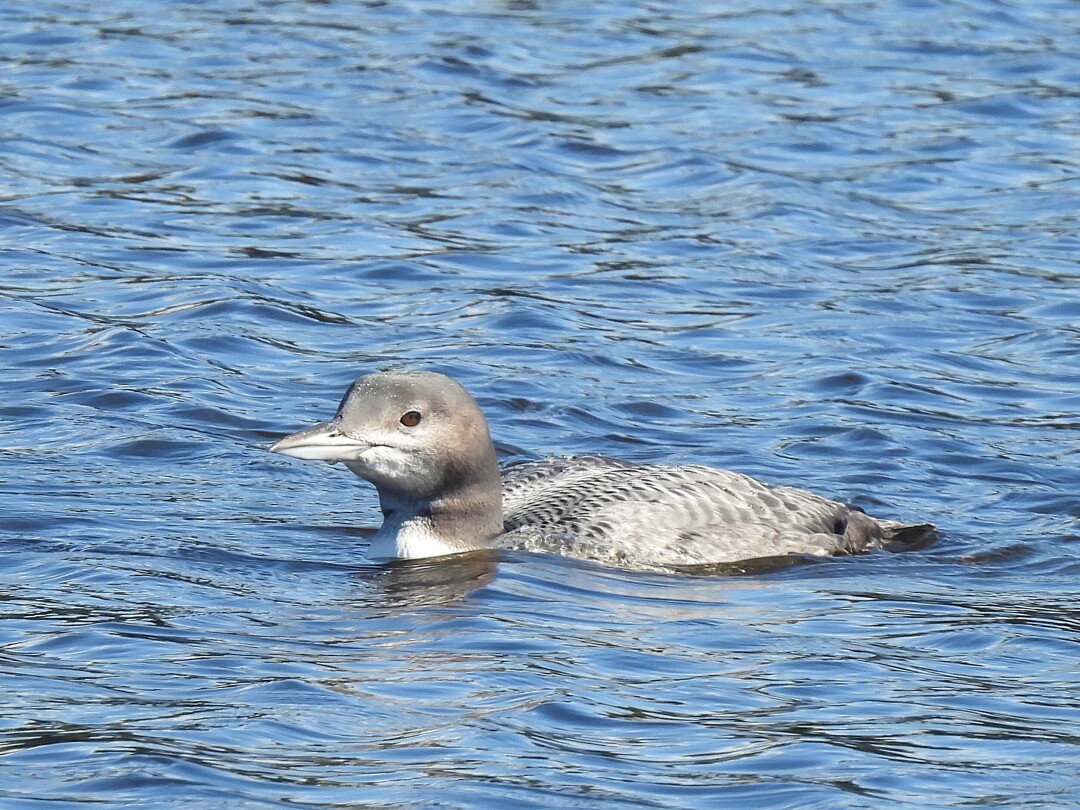
A juvenile loon. Photo by Emily Stone.
“Is that a loon?” Kevin pointed at a dark shape, just barely visible in the gray light of a cloudy afternoon. We aimed our paddleboards for a closer look. The shape turned sideways—showing the classic loon profile—then peered below the surface, then dove. Classic loon.
Smiling, I thought back to early summer sightings of this individual, when it bobbed like a brown fluffball next to parents and sibling. This loon family had the earliest hatch and oldest chicks within the range of my Loon Pontoon Tours all summer.
By late July, both chicks had molted into their smooth, light brown juvenile plumage, but they were still begging for food from their parents.
Now this juvenile seemed to be all alone. This is typical for loons. Adults migrate first. They need to get to the ocean or a large lake before they start to molt their flight feathers, since this renders them flightless for a time. Juveniles hang around a bit longer to build up fat stores and gain wing strength by flapping across the water. As long as they head south before the lakes freeze and their runway for takeoff is closed off, they should be fine. How they navigate to a place they’ve never been may always be a mystery.
“Look!” Kevin pointed just over my shoulder, where the juvenile loon had popped up moments before. We watched in awe as the loon cocked its head one way and then the other to examine us odd-looking ducks.
When the loon swam closer, we held our breath until, with barely a ripple, it dove. Our grins and delighted exclamations were interrupted when the loon surfaced again, even closer. Was it lonely? Was this the runt of the family? Will it have the time and the strength to migrate?
The period from when a juvenile loon leaves its natal lake to when it returns three years later as an adult is mysterious and dangerous.
By banding chicks and attempting to observe them again as adults, one study in northeastern Wisconsin has found that the juvenile survival rate has fallen from 41% in 2000 to 12.7% in 2019.
Are they starting their teenage years with fewer energy reserves? Are there new dangers in the coastal waters where they feed?
Despite the dangers that still await this bird, it is lucky to have made it through the chick stage. A groundbreaking study from Birds Canada that brought together data from 49 years (1975–2023), nine Canadian provinces and seven U.S. states just reported that the number of chicks reaching six weeks of age has declined by an average of 40% across North America.
There are many theories on what could be causing the decline in chick survival. Is volatile spring weather to blame? Have black flies chased too many loons off their nests? Has increased shoreline development infringed on their nesting habitat? Are raccoons and eagles eating more eggs, chicks or adults? Have declines in water quality reduced food or made loons sick?
These may all be factors, but in the northeastern Wisconsin study area, researchers think that increased rainfall due to climate change is the main reason that fewer chicks are surviving, and the ones who do survive weigh less.
A single storm can flood a nest or swamp the chicks. Rain washes fertilizers and other pollutants into the water. Sediment makes the water cloudy right away, and subsequent algae growth makes the problem worse. If a loon can’t see, it can’t catch fish.
Canadian researchers are now testing the impacts of water clarity across their study areas, too.
The loon popped up again. I thought back to 2020, the last year I volunteered for the population survey.
For decades in Wisconsin, loons have been monitored by the LoonWatch program, which was formerly housed within Northland College and recently spun off into its own nonprofit with the Sigurd Olson Environmental Institute.
LoonWatch conducted a statewide loon population survey every five years, and found that populations were stable. The trick was that the survey was really good at counting loon pairs on territories, but loon population dynamics are really good at making sure that all available nesting territories are occupied each year. If a member of a nesting pair dies, they will be replaced immediately by a “floater” loon who was biding its time.
For now, there are enough floater loons to keep the territories full. But with the decreasing reproduction rates and juvenile survival rates, scientists are worried that we’ll soon start to see significant declines in our favorite northern diver.
There is hope, though. Even though we can’t change the weather, humans can do a lot to reduce runoff and improve water quality, as benefits from the Clean Water Act and Clean Air Act showed.
Education and legislation restricting the sale and use of lead fishing tackle in Vermont and New Hampshire have increased the survival of adult loons there, and more states could follow suit.
We can live and recreate with care around loons to reduce death by propeller hits, fishing line and habitat loss. We all can help make sure this loon doesn’t get even more lonely.
Learn more at the Science on Tap event at the Deep Water Grille in Ashland, Wis., on Nov. 17, at 6:30 p.m. I will be talking about loons!
Emily Stone is Naturalist/Education Director at the Cable Natural History Museum. Her brand-new third book, Natural Connections3: A Web Endlessly Woven, is available to purchase at cablemuseum.org/books and at your local independent bookstore, too.
For more than 50 years, the Cable Natural History Museum has served to connect you to the Northwoods. Our Summer Calendar is open for registration! The Museum’s new exhibit, The Wetland Way is now open! Discover how life thrives at the intersection of soil and water, and why we must care for these special places as they care for us. Follow us on Facebook, Instagram, YouTube, and cablemuseum.org to see what we are up to.