The week in history
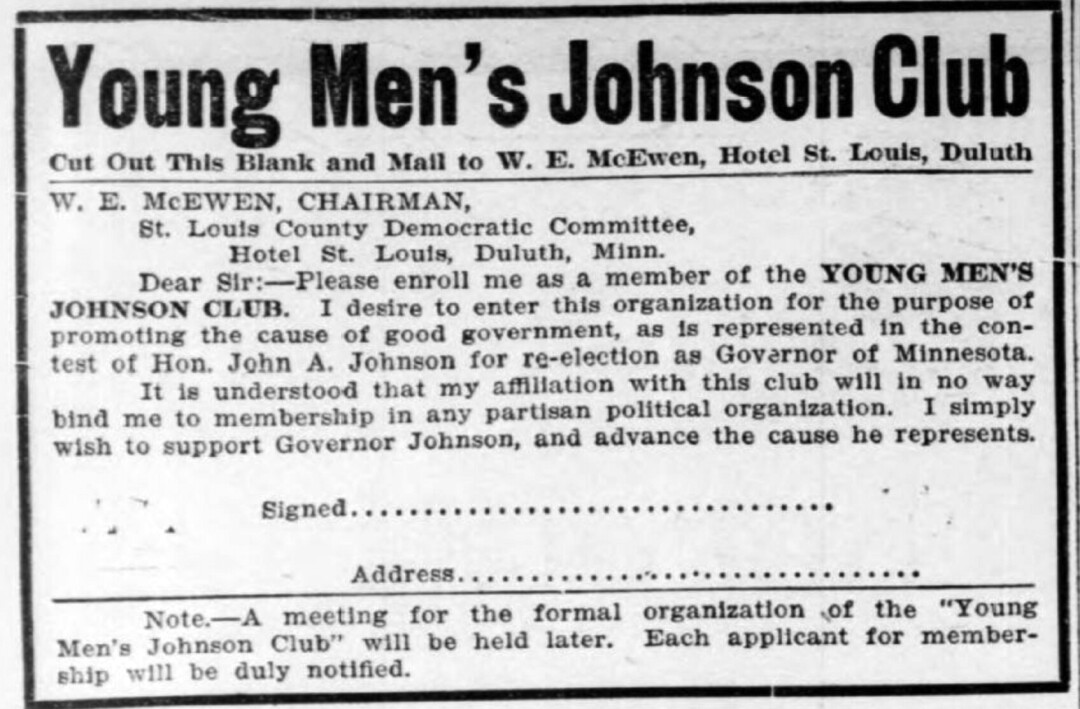
Duluth Herald, Oct. 24, 1906.
Duluth Herald
Oct. 22, 1888
HARVEST EXCURSIONS.
Another of the Popular Harvest
Excursions of the Northern Pacific Tomorrow.
The fourth of the popular harvest excursions of the Northern Pacific starts tomorrow and from the present bids fair to be as crowded as the former. The road has made surprisingly low rates to points all along; its line from Duluth, the round trip fare to Butte and Helena being but $30, considerably less than a cent a mile. The excursion is a very interesting one, taking a passenger through the vast wheat country tapped by the Northern Pacific and well into the mountains. The road furnishes the best accommodation, first class in every respect, and the tickets are good for 30 days with stop over privileges at any station on the line. Go and see the wonderful resources of the country through which the Northern Pacific runs. There are millions of acres of railroad and government land along the line open for settlement all of which is adapted for agriculture. There excursions, and there will only be one after that of tomorrow, have been the means of taking many thousands to the west and in no case has there been complaint of the treatment of excursionists by the railroad.
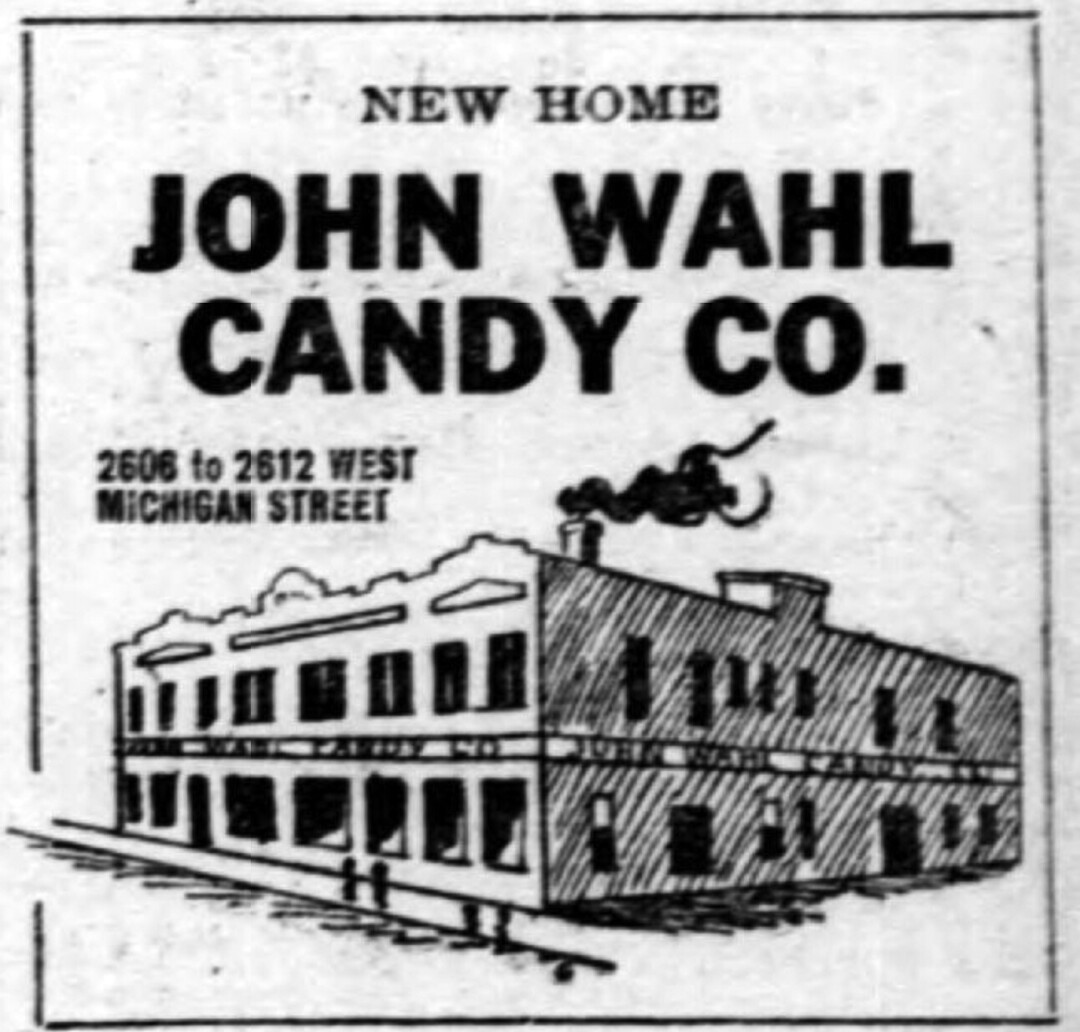 Duluth Herald, Oct. 25, 1916.
Duluth Herald
Oct. 23, 1896
REGISTER TOMORROW!
Register tomorrow or you
will lose your vote!
Tomorrow is the last day
for registration!
Voters of Duluth whose names are not enrolled cannot vote. The fact that you registered prior to the last election will not suffice; you must register anew this time or you cannot vote.
The booths are open tomorrow (Saturday) Oct. 24, from 6 a.m. to 9 p.m.
Outside of Duluth, residents of St. Louis county have one more day in which to register-next Tuesday, Oct. 27.
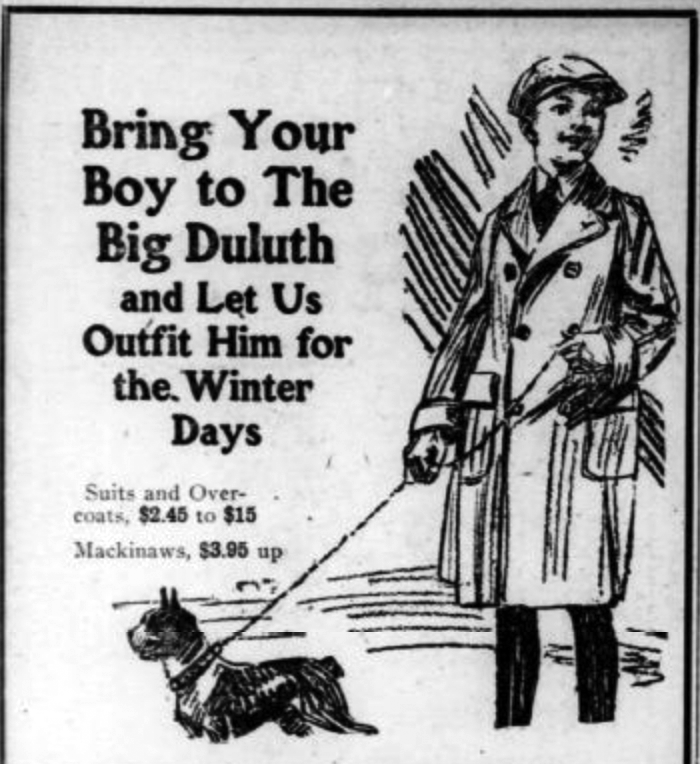 Duluth Herald, Oct. 25, 1916.
Duluth Herald
Oct. 24, 1906
GETS INTO
A BAKERY
Cow Creates Havoc in
West End Dealer’s Supply.
Cows are very useful animals, but some residents of the West end have come to the conclusion that they are great pests as well. Among these are Theodore E. Dahljeim, proprietor of a bakery at 2914 West Third street.
If they held such ideas before, they were certainly intensified last Friday. A rude cow visited both and left a trail like a marauding Confederate guerrilla before the fall of Richmond.
The animal casually strolled into Serge. Gillion’s front yard during that excellent officer’s absence from home, and proceeded to consume such flowers as had weathered the frosts. IT was not so much the loss of the flowers that the sergeant’s family deplored as was the fact that the cow punched many holes in the lawn with her four feet.
With only women on guard, the word the cow got at Gillion’s was a determined “shooing.” Then it went to Dahljeim’s bakery, entering the back way. Oh, this cow was a regular bovine Raffles.
It seems that Mr. Dahljeim makes a specialty of the manufacture of a certain kind of hard=tack which finds much favor in the West end and which in looks resembles a doughnut on which a mastodon has rolled and flattened out.
Mr. Dahljeim is said to be greatly behind in his orders for this delicacy. Some of it was standing in barrels in the back room of his place of business, ready for delivery. The cow espied the barrels upon entering the aforementioned back room and soon developed as much of a taste for the hard-tack affairs as any West ender. She appeared to have gotten away with the two barrels without any great effort.
After leaving the rear rom of the bakery shop, the cow went to the barn connected therewith. There she was found. The empty barrels and pieces of broken hard tack int eh shop[ caused a search for the thief and an unmistakable trail led to the stable.
The cow was locked in the barn and a hurry call made for the pound-master. That official arrived in due time and took charge of the culprit.
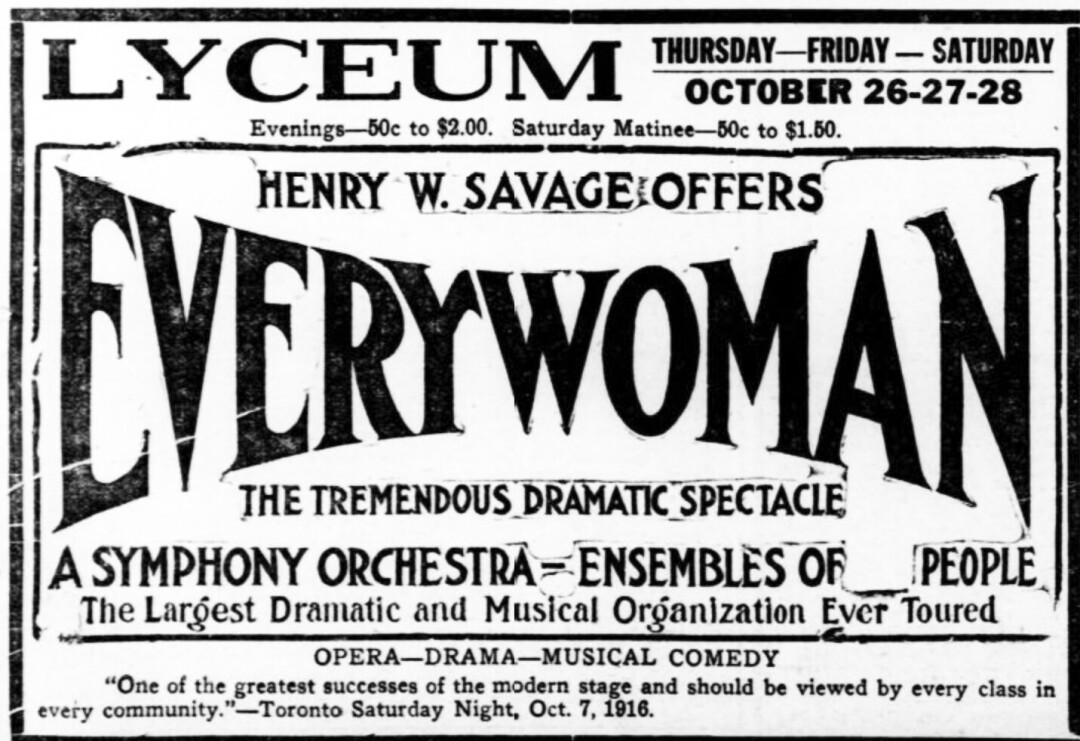 Duluth Herald, Oct. 25, 1916.
Duluth Herald
Oct. 25, 1916
DAILY DRILL
IN SCHOOLS
Recreation Director Suggests Substitute for Military Training.
Daily physical drill and daily supervised play in all the schools of the city, in place of military education, is proposed by J. R. Batchelor, recreational director.
America’s most prominent educators opposed military education in schools in addresses at the recreation congress held at Grand Rapids, Mich., early this month, according to Director Batchelor, who has written for detailed information on compulsory physical drills and supervised play for all grade school pupils.
If a plan can be worked out satisfactorily he will recommend it to the members of the school committee of the board of education, he said this morning.
The daily drill would be held during the classes, both in the morning and afternoon, including exercises, marches, chest expansions and physical culture. There would be special inspections of each child at least twice a year and the aim of the drills would be to make the children respect a command. Camps would be conducted each Sumer, but attendance on these would not be compulsory.
In addition, there would be one hour of supervised play every day, one half-hour each in the morning and afternoon.
The plan has been established in New York State and detailed information on the plan has been published by the New York university.
 Duluth Herald, Oct. 26, 1926.
Duluth Herald
Oct. 26, 1926
GASOLINE PRICE
DROPS ONE CENT
IN DULUTH AREA
Gasoline, all grades for all companies in Duluth today, is down 1 cent, making the service station price 21.5/10 cents, plus the state tax of 2 cents a gallon and tank wagons 19.5/10 cents, plus the tax.
The reduction followed announcement made by the Standard Oil Company of Indiana that that company ordered the reduction effective today on gasoline and also on kerosene. Kerosene is now 15.1/10 cents a gallon.
General market conditions were announced by the Standard Oil company as the reason for the decrease, which is effective in eleven Middle Western states. In Chicago, headquarters of this district, the tank wagon price now is 18 cents and service station 20 cents a gallon.
The 2-cent higher price here results from the freight charges from the refineries to Duluth, local officials explained today.
All gasoline companies of the city made the change today.
 Duluth Herald, Oct. 27, 1936.
Duluth Herald
Oct. 27, 1936
BUSSES TO USE
TROLLEY STOPS
Curb Loading Zones
To Be Eliminated.
Beginning tomorrow all gasoline barter busses operated by the Duluth-Superior Transit Co. n the city will use the regular trolley bus-street car stops, it is announced by B. G. Noah, general manager.
At the same time, Lieut. John Englert, head of the police traffic bureau, announced that the curb bus stops through the downtown business district used by the interstate busses of the company will be eliminated. These spaces will provide additional parking space in the downtown area.
The new schedule applies especially to the Duluth-Superior interstate busses and also the Park Point busses and any other gasoline busses the company may operate on occasion or during rush hours to augment the regular service.
Busses leaving the car barns at Twenty-sixth avenue west and returning, and in Garfield avenue, South Lake avenue and Minnesota avenue will follow the regular street car and trolley bus lanes in the middle of the street, stopping at the usual zoned steps.
 Duluth Herald, Oct. 29, 1956.
Duluth Herald
Oct. 28, 1946
Blatnik Raps
War Veteran
An attack against a World war veteran, Ray H. Beardsley, Deer River, was made yesterday by John A. Blatnik, Chisholm, Democratic-Farmer Labor candidate for congress in the Eighth district.
Blatnik, according to a press release made in Duluth, charged that Beardsley and the Deer River News had published statements “to the effect that he (Blatnik) was a Communist.” He hurled charges of “lies” at Beardsley and the weekly newspaper editor of the Deer River News.
He challenged them to produce proof. Beardsley more than a week ago challenged Blatnik to a public debate “Anywhere at any time.”
“Blatnik said, “I categorically denounce and brand as outright lies the Deer River News and Ray H. Beardsley’s accusations of my being a Communist and a Titoist.”
Tito became a prominent part of the Eighth district campaign back in July and remains as one of the issues.
It was Blatnik’s contention that he had passed the tests of the Office of Strategic Services successfully and that it disproved charges of Communism against him, adding “Mr. Beardsley and the Deer River News themselves would very probably find it a job to pass those tests.”
According to the press release, Blatnik made these statements, along with a summary of his record as a state senator during the period he served, at meetings in Proctor and Deer River.
 Duluth Herald, Oct. 29, 1956.
Duluth Herald
Oct. 29, 1956
Airmen Clean
Base After
Open House
Today is cleanup day at the Duluth air base, following the weekend “open house” celebration attended by an estimated 65,000 spectators.
Highlight of the activities was the public introduction and demonstration of the F102A supersonic jet interceptor.
Last night, after most of the visitors had departed still hearing in their ears the mighty thunderclap sound of the supersonic boom, the men at the base held a hangar party.
By this morning most of the visiting “brass” also had left, and the men set about getting into normal shape. Gen. Jarred Crabb, Central Air Defense Force commander, was planning to leave later today for his base at Kansas City.
The supersonic boom which marked the breaking of the sound barrier was heard for about 20 miles and shattered some windows Saturday. The air force said it would take care of the damage.
 Duluth Herald, Oct. 31, 1966
Duluth Herald
Oct. 31, 1966
Apartment House Shapes Up
Construction of the first two apartment houses at a combined cost of a half million dollars has started in the Kenwood district.
Earl Richards, the builder, said the first building near the junction of Kenwood Avenue and Arrowhead Road, will be finished in late winter. Construction of the second is scheduled to start next spring. Each will cost $250,000. They will face each other on opposite sides of Outlet Street, an extension of commercial zoning in the Kenwood Shopping are to permit the buildings. The site formerly was zoned for single-family dwellings.
Each building will contain 21 units, one single-bedroom apartment, 17 with two bedrooms and three with three bedrooms. Rentals will range from $170 to $195 monthly.
The two-story structures will be brick n=veneer. They will have off-street parking.
This is Richard’s first venture in apartment house construction. He previously has built single family dwellings.
The buildings will be the seventh and eighth apartment houses constructed in Duluth within the last three years.