Modes of misery
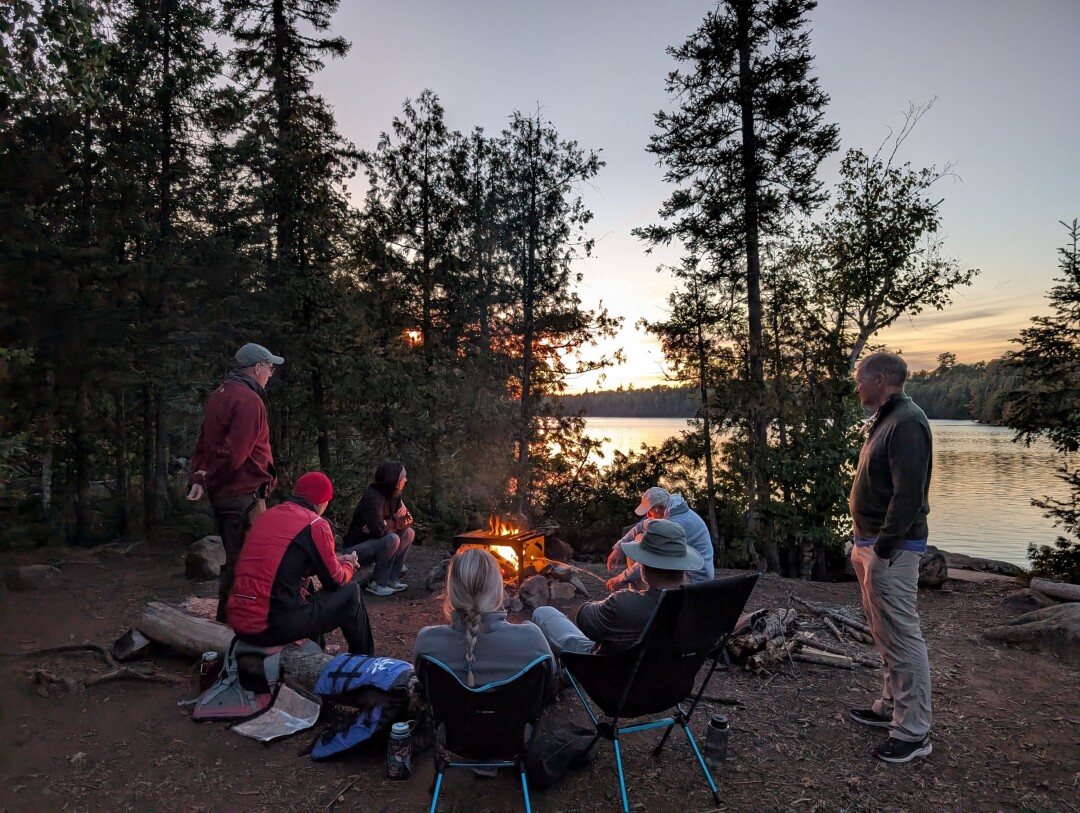
Gathering around a campfire at the end of a long day is one of the best parts of a Boundary Waters canoe trip. Photos by Emily Stone.
“In many ways, a canoe trip is an endlessly repeated exercise in various modes of misery, each one a contrast — therefore, a relief, albeit temporary — to the misery preceding it. So there is always the illusion of looking forward to something that will most likely be…another misery.”
Douglas Wood, Paddle Whispers, pg. 107.
Around the fire grate, both the people and the coals of our s’mores fire shifted restlessly in the deepening dusk.
After a long day of paddling and portaging it was hard to get comfortable on the sitting logs in our Boundary Waters campsite. But that made Doug Wood’s words resonate even more.
I’ve been reading this tongue-in-cheek passage to participants on the Cable Natural History Museum’s “Boundary Waters with a Naturalist” trips since 2014.
Even though they may have sore muscles, I’ve found that the long and amusing list of miseries Doug rattles off are a way to make the participants grateful for my good leadership.
We weren’t attacked by mosquitoes and other “evil incarnate,” because I schedule these trips in the fall. We don’t carry “loads that would crush a burro,” because I make sure we have lightweight canoes, gear and food. The mini-bears (chipmunks) do not get our food because we pack it in bear cans and keep a clean camp.
But my favorite part is when he gets to the point. “So why…why go through it? Why even be here? The second answer is easy. Because ‘here’ is where the beauty is. Here is where the sunsets are…”
As I finished reading that sentence, Steve interrupted to point out a beaver who was rippling the still water in front of our rocky point. The beaver dove, but as we stood and tracked his trajectory to the west, we discovered that the setting sun had flung streaks of orange cirrus clouds across the sky’s gradient of blue.
 A swimming beaver, visible as a V in the water, caught our eye at the campsite and helped us notice a beautiful Boundary Waters sunset.
Perhaps the beaver was in cahoots with Mr. Wood!
It was lucky I’d stopped reading, or else I wouldn’t have noticed as faint sounds began to add new texture to the northern sky. A large skein of geese appeared over the treeline, flying high above the beaver’s own rippling V and honking with excitement about their next challenge.
“Here is where the journey is,” philosophized Doug Wood when I finally picked the book back up. “…why do I go through it? Because no one else can go through it for me.”
It’s true. And I love going through the challenges of a canoe trip. Planning, paddling, portaging, wayfinding, camping and even cleaning up once I’m back home, all carry a satisfying amount of effort and reward.
Plus, there are the sunsets.
I wonder, how do geese feel about their endless modes of misery?
They’ve just finished a race to raise their goslings and molt into a fresh batch of feathers to be ready for migration. Now they must hurry south ahead of winter and find habitat in a new place.
Some geese fly all the way from the High Arctic to the southern U.S. Others may only go as far south as a reservoir in Iowa, but what if new development has paved over their favorite lawn or dredged a wetland?
I’ve definitely experienced the misery of not finding a campsite or portage where the map indicated they should be.
Then after scrounging for food all winter, the geese test the truth of spring to arrive back on their territory and begin defending it from others. Rain, cold, hungry predators and hunger itself threaten their eggs and chicks as they race once again to be ready for migration in fall.
It’s not an easy life, but no one else can go through it for them.
Back home, from the cushioned seat of a pontoon boat, I watched the two juvenile loons in Lake Namakagon seize fish from their parent’s beak. Their lives, too, are an endless series of challenges.
Grow up fast, migrate far, spend three years on the ocean trying to find food and avoid dangers, then return north, only to battle violently to win a territory so that they can have hungry chicks snatch food from their beaks, too.
We were bobbing lazily on gentle waves, but does a loon ever fully relax?
A flash of movement above the boat turned our attention to the teetering flight of a monarch butterfly clearly heading south.
It’s amazing that those paper-thin wings can carry millions of monarchs to Mexico. We make that trip for vacation, but for butterflies, it’s survival.
Do they ever enjoy a moment of bliss on a sun-warmed flower?
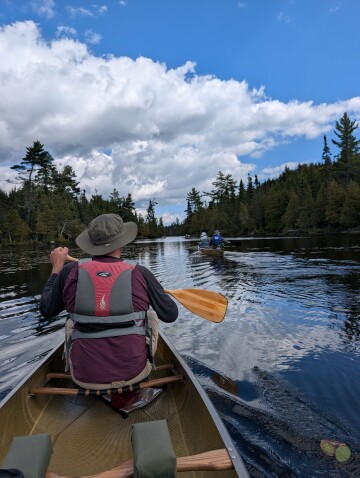
“Here is where the journey is,” said Doug Wood, obviously thinking about canoe country.
But that statement applies to all of Earth. All around us an uncountable number of journeys are unfolding. I’m doubtful that a goose or a butterfly registers their long flight as a misery. I’d like to think their muscles are in better shape than mine. But I am certain it’s a challenge.
And hopefully, each stage of their life’s journey carries a satisfying amount of effort and reward. Maybe they even enjoy the sunsets.
Emily Stone is Naturalist/Education Director at the Cable Natural History Museum. Her award-winning third book, Natural Connections3: A Web Endlessly Woven, is available to purchase at cablemuseum.org/books and at your local independent bookstore, too.For more than 50 years, the Cable Natural History Museum has served to connect you to the Northwoods. Our Summer Calendar is open for registration! The Museum’s new exhibit, The Wetland Way is now open! Discover how life thrives at the intersection of soil and water, and why we must care for these special places as they care for us. Follow us on Facebook, Instagram, YouTube, and cablemuseum.org to see what we are up to.t our classroom exercise will help them learn to read the stories of the forest.