This week in history
 Duluth Herald, Sept. 11, 1896.
Duluth Herald
Sept. 10, 1888
OF GENERAL INTEREST.
A little son of J. W. Richardson, a resident of Helm’s addition, fell from a horse this morning and broke an arm. He was riding the animal along the road, when it shied at something, throwing the boy to the ground with the above result.
The funeral of James Twaddle, the unfortunate lumberman who was drowned Saturday morning at Connor’s Point, occurred yesterday.
The Athletics, failing to show up yesterday at the Base ball park, the Mets played a scrub team beating them 16 to 10.
Alderman Kennedy and his family leave for St. Paul the latter part of this week to attend the state fair and exposition.
Boats are unloading 4,500 tons of coal at the old Northwestern dock today.
Two slightly unsavory citizens of Oneota tried to paint that town ed Saturday night and succeeded so well that they spent Sunday in the lockup. They both paid fines.
 Duluth Herald, Sept. 112 1906.
Duluth Herald
Sept. 11, 1896
SHOT THE OFICER.
Suspicious Characters
Vigorously Resist Arest.
Officer Joe Ryan was shot through the hand while he and Officer Irvine were attempting to round up four suspicious characters on Superior street, near First avenue east, at 2:30 o’clock this morning. Three of the crowd, including the one who wounded Ryan, escaped, but the fourth was taken to the station, where he gave the name of James Cunningham. On being searched, a complete kit of burglar’s tools and a 38-caliber revolver were found on his person. In one of his pockets was found a postal card from Lasky, Payne & Co. of Chicago, acknowledging receipt of $2,90 for same goods, the nature of which is not stated. The prisoner is about38 years of age, and has decidedly the appearance of a crook.
Officer Irvine had spotted the man a short time previous in the tenderloin district. He followed them toward Superior street, being joined by Officer Ryan, whom he met on the way. The suspect went up First avenue east to Superior street, and walked west as far as the Saratoga restaurant, where they stopped, and the officers approached and placed them under arrest. Irvine and Ryan started the prisoners in front of them toward the central station.
At First avenue east the prisoners broke and ran in various directions, one of them going up that thoroughfare, pursued by Irvine. The fugitive dodged in back of the Stenson block, where Irvine ran him down, finding him in the act of throwing away a lot of burglar’s tools. As Irvine grabbed him, the fellow struck at him with a heavy iron bar, such as is used by burglars as a brace. The officer dodged the blow, knocked his man down and subdued him.
Meanwhile Ryan had pursued another member of the gang down first avenue east, firing his revolver twice to bring him to a stop. At the second shot, the man turned and fired, the ball going through Ryan’s left hand. The latter staggered for a moment, but quickly renewed the chase, his man escaping, however, among the cars at the first railroad crossing.
The shots attracted the attention of Sgt. Kenna, at the central station, who, with Officer Hawksworth, hastened to the scene, arriving too late, however, to be of any assistance.
 Duluth Herald, Sept. 12, 1906.
Duluth Herald
Sept. 12, 1906
CHANCE FOR
DETECTIVES
Amateur Sleuths Have Opportunity
to Land Big Reward.
Murderer of Freddie Mitchell
May Be Hiding Here.
Is the brutal murderer of little Freddie Mitchell hiding in Duluth, and is there a chance for some Duluth person to land the reward that has been offered for his capture?
The reward now amounts to quite a snug little fortune, $2,060 in all (Editor’s note: approximately $75,000 in 2026 dollars), and it is a glittering prize to hang before the eyes of the amateur detectives, as well as the professional thief catchers.
The reward has been swelled by $500 contributed by the state. This amount, with that contributed by the relatives of the murdered boy, the railway company, the county and the Humane society makes a total of $2,060, which is a very substantial sum and should make the sleuths put forth their shrewdest efforts on the case.
Putting aside the theory that the murderer is in hiding somewhere near Bennett, the scene of the crime, the probability is that he would immediately set out for Duluth, this being the only large city within easy reach that would offer a safe and reasonably sure hiding place.
It was two days after the crime had been committed before the body was found, and this gave the murderer a start of forty-eight hours. During that time he could have easily reached Duluth either by walking or by stealing a ride on an ore train, and he may by this time have skipped out as a laborer or he may still be hiding about the city.
There is little for sleuths, professional or otherwise, to work on but there is just a fighting chance that the fiend is in Duluth and that some Duluth person will land the reward for his capture.
 Duluth Herald, Sept. 12, 1906.
Duluth Herald
Sept. 13, 1916
PROSPEROUS
FORGET GOD
Evangelist Aldrich Scores rich
for Refusing to Follow Christ.
Rev. A. Lee Aldrich, in his sermon at the tabernacle last night, scored the prosperous for forgetting God and said that it was the poor people and not the rich who put through revival campaigns. More than 1,800 attended the meeting despite the rain. Failures on the part of men and women to make the decision, which, he said, would send on to heaven or hell were due to refusal to take responsibility.
“If I could go back and pick out sixty moments in the life of any person in the building, I could sum up your whole life in one hour,” he said. “Every man and every woman has faced at some time a crisis, a moment when great decisions were made and that decision made in a moment’s time has decided their life.
For Best Christians.
“It is the poor people today who keep the church from going out of business. IT is the poor people who know Jesus. It is the poor people who put on this campaign and paid for it. Where there is prosperity God is forgotten. It was not the highbrows who put this campaign through.
“I believe when a man wants to do right he has all the forces in heaven and earth to help him and usually a good woman. When a man wants to do wrong all the evil forces in earth and hell stand ready to drag him down. Men will do anything to keep God away. It surprises me how much a man will do to go to hell and how little he will do to go to heaven.”
Twenty-two ministers attended a meeting yesterday at the Y.M.C.A., when Rev. Mr. Aldrich spoke on “True Evangelism.” Following the sermon, a discussion of the methods of evangelism was held.
“Religious leaders have disagreed upon the needs of the age,” said Rev. Mr. Aldrich to the clergymen. “While the controversy rages, the sin-sick perish for want of help. It is the devil’s business to sidetrack men.”
 Duluth Herald, Sept. 14, 1926.
Duluth Herald
Sept. 14, 1926
OLD DOBBIN PASSE,
CITY FATHERS RULE;
FOUNTAIN MUST GO
Old Dobbin received another severe blow yesterday. And from no less personages than the august commissioners and fathers.
On motion of Commissioner P. G. Phillips, public works department, commissioners voted the removal of the horse watering fountain at the Eighth avenue west and Michigan street-Superior street intersection. This fountain is very little used of late with the increasing number of motor trucks and cars, it was said, and is taking up street space that could be used otherwise.
With the removal of the fountain, only one more remains downtown. This one is located at Ninth avenue east and Superior street, where it intersects with London road.
 Duluth Herald, Sept. 15, 1936.
Duluth Herald
Sept. 15, 1936
QUOTAS GIVEN IN DROUTH AID
500 Are Listed for County,
Morin Announces.
Readjusted quotas for the employment of persons in occupational classes affected by the drouth, with the figure set at 500 for the Duluth district, were announced today by Henry L. Morin, district WPA director, following word from Victor Christgau, state administrator.
St. Louis, Itasca and Carlton counties, all in the Duluth district, have been designated as drouth areas. Koochiching county is seeking to be designated as a drouth region in order to receive aid.
Assignments in the drouth area ae being made upon recommendation by representatives of the Resettlement administration and certification by local and district representatives of the coordinated field service.
As rural areas of 45 counties in the state recently began to feel the full economic effect of the drouth, the drouth quota of the state was increase from 6,000 to 15,000 recently at the request of Mr. Christgau.
Duluth Herald
Sept. 17, 1946
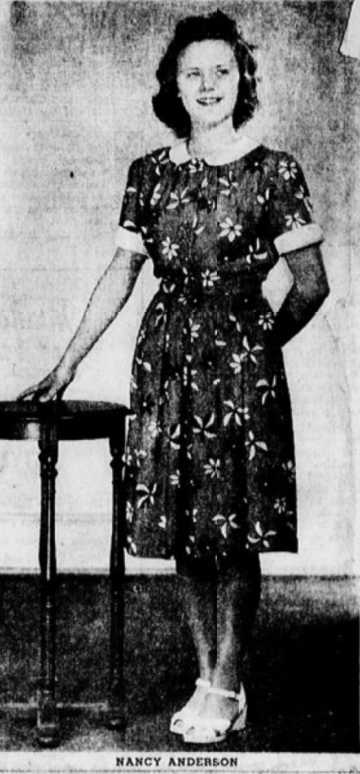
Style Queen to Compete
Nancy Anderson Is Champ of Area
The Anderson twins – Mary and Nancy – daughters of Mr. and Mrs. Oscar Anderson, Maple Grove road, for the last seven years have acquired multiple achievements in 4-H club projects, and are still going strong as twin feature performers.
This year Nancy is south St. Louis county dress revue champion, a title won in 1945 by her sister, Mary, and will compete with 12 other county and area winners of northeastern Minnesota for the honor of being a candidate for the statewide honor of style queen.
Plans for the district contest were announced here today, with the competition to be held in connection with the 13th annual Northeastern Minnesota Junior Livestock Show at the Duluth Curling club Oct. 3.
Nancy won trips to the Minnesota state fair in 1942 and 1944. She was county and district champion in radio public speaking and placed fourth in the blue ribbon group in the 1942 clothing project. Mary, as 1945 county dress revue champion, placed in the blue ribbon group at the state fair, and in 1943 she was champion in the clothing exhibit project and was named grand champion for her canning exhibit.
In addition to the district dress revue contest in Duluth, the district health contest will be held.
 Duluth Herald, Sept. 17, 1956.
Duluth Herald
Sept. 18, 1956
Scholastica Lists
Large Increase In New Students
Classes began yesterday at the College of St. Scholastica with heavy increases in new students and enrollments in the fields of nursing and elementary education.
New student enrollment was 175, compared to 125 a year ago. Total registration is expected to be over 350 by the end of this week. New dormitory rooms have been opened to take care of 30 additional resident students.
Officials said enrollment in nursing and elementary education is one-third greater than last year. Opening week events include a buffet supper Thursday evening honoring the Rev. Mother Martina, prioress of the college, and a traditional bonfire on the lower campus Friday sponsored by Kappa Zeta sorority.
Enrollment is predominantly from Minnesota, Michigan and Wisconsin, but there are two students from Japan, five from Puerto Rico, one from Guam, two from Canada, one from California and one from New York.
 Duluth Herald, Sept. 17, 1946.
Duluth Herald
Sept. 19, 1966
You Can Still Shop
No Buyer Yet for Market Site
Duluth’s Farmers’ Market us saved – at least temporarily.
St. Louis County Commissioner Joseph C. Priley said today that the Farmers’ Market may continue to operate on its present site at 14th Avenue East and Third Street as long as there is no buyer for the property.
A potential buyer appeared last spring and the County Board notified the Market Growers’ Association, which operates the market, that this possibly could be the last year of the operation where Duluthians purchase vegetables and fruits freshly picked on area farms.
The county Bord was besieged with letters, petitions and telephone calls pleading that the Farmers’ Market be spared. Priley said the potential buyer apparently has lost interest in the property and there is no need for the Farmers’ Market to be forced of the tax-forfeited land on which it is now located.
The present Farmers’ Market is the last such operation in Duluth. The first was built by the Agricultural Council of the Duluth Chamber of Commerce in 1922 at Sixth Avenue East and Third Street. There more were built in 1924. One was placed next to the original building at Sixth Avenue East and Third street, another at 24th Avenue West and First Street and the third at 57th Avenue West and Ramsey street.
Interest in the markets began to wane and during World War II, the ones in the West End and West Duluth closed. By 1952, only the market at Sixth and Third remained. When this land was sold, the building was dismantled and moved to the present Farmers’ Market site.