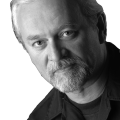
Pianist Alex Sandor is set to deliver Gershwin at DSSO opener
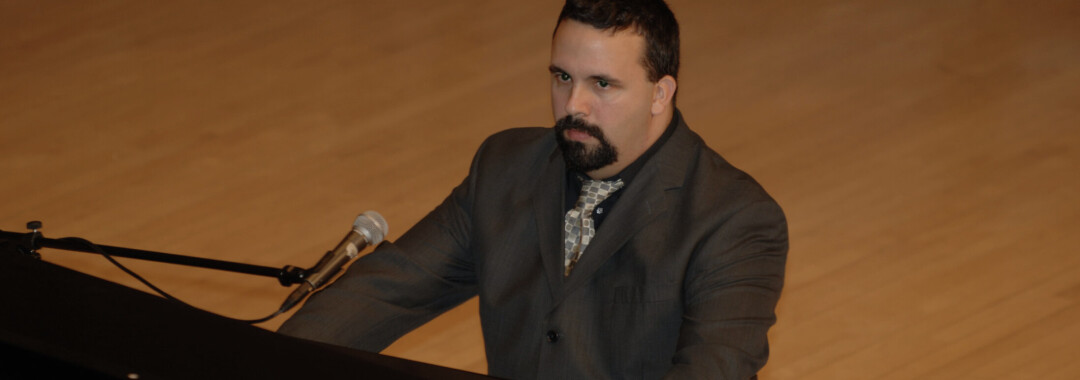
The Duluth-Superior Symphony Orchestra (DSSO) will launch its highly anticipated new season on Saturday, Sept. 19, with a high-energy program titled “America in Motion.”
Performing live at Symphony Hall, the orchestra promises an evening that celebrates the momentum, syncopation and diverse genres of American music.
At the center of this season opener is a musician whose history with the DSSO is woven into the very fabric of the Twin Ports community: principal pianist Alex Sandor.
For local classical music lovers, Sandor is a familiar figure. Though he officially stepped into the principal chair nearly two years ago, he has been performing as a substitute with the orchestra since his days as a college student.
Sandor famously cemented his legendary status with the DSSO back in 1996. With a mere 24 hours’ notice, a young Sandor was called upon to fill in for the featured performer to perform Beethoven’s majestic Emperor Concerto.
“I went into the practice room and practiced, and that’s about it,” Sandor recalls of that whirlwind day. “I took a long hot shower to relax before. It was kind of nice because, on such short notice, you don’t really have time to get in your own head and make yourself nervous. So I just went and did it.”
Orchestra management had kept the last-minute substitution quiet, fearing a drop in ticket sales. Instead, the audience was treated to a breathtaking performance by a local prodigy.
“They seemed to love it,” Sandor says. “They were super enthusiastic. I think they really appreciated the fact that I was local, and that I was pretty young.”
A life lived under the piano
Sandor’s fearless versatility is deeply rooted in his upbringing. The son of a medical technologist (and passionate amateur musician) and an arts-loving mother, Sandor was marinated in music before he could even walk.
As an infant, his parents would place his blanket directly underneath the piano while his father practiced. He even spent his toddler years playing beneath a harpsichord his father built from a kit.
Though he initially hated traditional piano lessons in second grade, a broken arm in the fifth grade forced a temporary hiatus. When he healed, his mother found a teacher who changed everything by fostering his natural creativity.
“She kind of snuck the teaching in on the side without me noticing,” Sandor laughs.
That creative freedom allowed him to absorb everything from classical masterpieces to ragtime — the latter inspired by Twin Ports ragtime icon Yvonne Cloutier, who co-founded the Lake Superior Ragtime Society with Sandor’s father.
Today, Sandor serves as president of the Lake Superior Ragtime Society. While classical music is his true passion, Sandor said ragtime is perfect should someone call upon him for an impromptu performance.
Tackling a Gershwin masterpiece
For the Sept. 19 concert, Sandor will put his multi-genre expertise to the test with George Gershwin’s rarely performed Second Rhapsody and his “I Got Rhthym” Variations.
While audiences worldwide are intimately familiar with Rhapsody in Blue, the Second Rhapsody offers a fresher, more complex exploration of American jazz and classical styles. The Second began life as a montage sequence for a 1931 film that George and brother Ira wrote for called Delicious. The montage was to feature a character wandering New York, and the musical piece George wrote for it was originally called Manhattan Rhapsody, and then New York Rhapsody, and, finally, Rhapsody In Rivets. After completing the montage sketch, George returned to New York and turned the sketch into the Second Rhapsody.
Preparing for the piece required months of meticulous, disciplined practice. Sandor began by sourcing a handful of recordings on YouTube to internalize the unfamiliar structure, before chipping away at the score line by line.
“I try to find a lot of different ways of practicing so that I wouldn’t just do the same drills,” Sandor explains. “I’d practice one passage in 20 or 30 different ways, and then start stitching the parts together into bigger and bigger chunks.”
During his research, Sandor unearthed a rare historical gem: a test recording of Gershwin himself rehearsing the piece at the piano.
“A lot of the piano parts that Gershwin played were different from what is currently in the score — some radically different,” Sandor notes. “It was fascinating to hear the process of composing. You could hear the iterations as he edited himself.”
A Season of Motion
The DSSO’s 2026-27 season is titled American Wonders, celebrating “the beauty, spirit and musical legacy of America in its 250th year.
The season gets a massive jumpstart with the Sept. 19 “America In Motion” concert, beginning with John Mackey’s explosive, rhythmic Redline Tango, a work that promises to set a thrilling pace for the evening and the season.
From there, the night will carry listeners through a rich tapestry of American sound, anchored by Sandor’s performance of the Gershwin rhapsody variations on “I Got Rhythm.”
The evening proceeds with Duke Ellington’s The River Suite, a jazz ballet commission Ellington was asked to do to celebrate the 30th anniversary of the American Ballet Theatre.
The night concludes with more Gershwin in the form of his jazz-tinged symphonic tone poem An American in Paris.
A little side note on the piece Gershwin wrote in 1928, while America was in the throes of the failed social experiment of Prohibition. An American In Paris is just that – and that American is subject to the dizzying Parisian culture, which includes wine.
There is reportedly a letter Gershwin wrote giving his support for using An American In Paris for an anti-prohibition concert.
Looking past opening night, the Oct. 24 concert, titled “Close to Home,” promises a “love letter to finding heaven in everyday moments,” which I believe is truly exemplified in one of my all-time favorites, Mahler’s Symphony No. 4, with soprano Laquita Mitchell.
“Under Open Skies” is the title of the Nov. 21 concert, which opens with Copland’s An Outdoor Overture and ends with Dvorak’s Te Deum.
Across the Sea, the Jan. 23 concert, feature’s Beethjoven’s Coriolan Overture, Sea Portraits by Stephen Paulus and Brahms’ stormy Piano Concerto No. 1.
The Feb. 23 concert begins with Charles Ives’ Variations on “America,” followed by Schubert’s Unfinished Symphony, Bach’s Cantata No. 4 and, finally, Elaine Hagenberg’s Illuminare.
New Frontiers on May 15 closes the Masterworks season with the world premiere of DSSO Concertmaster Erin Aldridge’s Fiddle Concerto No. 1, “Smoky Gold,” so called because she shares the stage with the band Danny Frank & the Smoky Gold. Amy Beach’s Bal MAsque, op. 22, opens that concert and Copland’s Symphony No. 3 ends it.
Sandor is incredibly optimistic about the upcoming Masterworks calendar, but first, the orchestra must set the wheels in motion.
“It’s going to be an awesome concert,” Sandor says. “I’m really excited to play, and I’m looking forward to it.”