This week in history
 Duluth Herald, Sept. 12, 1966.
Duluth Herald
Sept. 3, 1888
Labor Day.
Organized Labor’s First Annual Picnic
in Duluth – A Jolly Day for Hundreds.
Early this morning the French band was playing along the streets and at the West End reminding laborers of the fact that today was the annual holiday of the federations of labor and that it was to be observed in Duluth. But few laboring men heeded the call though their families quite generally repaired to Brautigan’s summer garden at the East end where they spent the day in quiet picnicking and games. A meeting of the labor organizations was held Saturday evening at which it was decided that no effort should be made by the men to leave their work to attend, the season already being far advanced and work having been light.
Long before the busses which were running to the picnic grounds had conveyed many people there and would have taken more but for the rains of early morning and the threatening skies. A program of amusements was caried out, its opening being a game of ball between two picked nines, which was witnessed by a large crowd.
The addresses are to be followed this afternoon by games of various sorts. There is also to be dancing should the weather permit this evening, the French band furnishing the music.
 Duluth Herald, Sept. 4, 1896.
Duluth Herald
Sept. 4, 1896
THE WILD WEST SHOW.
Maj. Burke, the General Manager,
is Here Today.
Maj. John M. Burke, general manager of Buffalo Bill’s Wild West show, is in the city today, looking after details connected with the appearance of the great show. Maj. Burke has been associated with Col. Cody for many years. He traveled with the Wild West show all over Europe, visiting London, Paris, Brussels, Vienna and all the great capitals of that continent. He is one of the pioneers of the West and a man of most pleasing demeanor and genial address.
“Buffalo Bill has always had a warm spot in his heart for Duluth,” said Maj. Burke today. “Wen the Manchester canal was begun a number of years ago his show was over there and he caused a large map to be drawn on canvas. This showed the extreme limit Manchester canal could extend westward by water. This was to the head of the lakes and Duluth was the point to which attention was called as being farthest inland.
“The show which will be presented here will be greater than that shown in London and Paris and exactly the same as that given in Chicago. It is no small undertaking to visit Duluth, for you are somewhat out of the way, but I am quite sure we shall not regret it. We carry 500 horses and nearly 600 men, which gives an indication of the magnitude of our show. The performance will be given in the open air. An amphitheater seating 18,000 people will be erected in the shape of a horse shoe. This will be sheltered from sun and rain, but the arena will be open.
“Many people for some reason seem to think Buffalo Bill is not with the show. I wish to say positively that he is and he will ride the war horse presented to him by Gen. Miles, commander of the United States army.”
One of the features of the visit to Ashland will be a festival of peace between the Chippewas around there, 1000 of whom are expected to attend, and the Sioux who are with the show. These tribes have always been bitter enemies heretofore.
Maj. Burke will be here until tomorrow and will leave then for the Twin Cities.
 Duluth Herald, Sept. 6, 1916.
Duluth Herald
Sept. 5, 1906
RESULT OF
ORDINANCE
Death Rate of Infants from Tuberculosis Reduced 80 Per Cent.
Two Years’ Operation of Milk Ordinance Demonstrates Necessity.
The infant death rate from tuberculosis reduced 80 per cent within the two years that the city ordinance for the inspection of diary cows and stables has been in effect is one of the most interesting statistics found in the record of the health department of Duluth. To those who advocated the ordinance and who have been working hard for its observance this record is very gratifying., the decreased death rate among children being pointed out as the best evidence that the ordinance was just what the city needed.
Last spring the health department tested about 3,400 dairy cows for tuberculosis and it is estimated by Dairy and Milk Inspector Moeller that fully 4,000 will be tested the coming spring when the department again makes the rounds. Milch cows are coming to Duluth at the rate of about three carloads a week, twenty-five cows to the car and the dairy herds are being increased to a considerable extent.
The health department has the inspection work down to a point where no cows are being shipped into Duluth and distributed without being tested for tuberculosis. The dairymen were rather unfriendly to the dairy and milk ordinance immediately after it was passed and some little trouble was had over its enforcement, but that feeling has disappeared long ago and, the dairymen are, almost without exception carefully observing the provisions of the ordinance.
Before the ordinance went into effect cows were shipped to this point by the carload for distribution and scattered out among the dairymen and farmers. Very often a diseased cow was among the herd herds shipped in but the department had no way then of locating such animal or making the test for tuberculosis. Threw re instances, it is said, where the dairymen who came to know that one or more of their cows was affected with tuberculosis would continue to sell the milk rather than take a loss by killing the animal.
Under the present system not a single cow is sold from the herds that come in here until it has been tested by an inspector from the health department. The local dairymen will not buy a cow now unless she has “a clean bill of health,” which in this case means a tag bearing the inspector’s name and stating that the cow is free from disease.
The tuberculosis test is made free of charge and is said to be infallible.
 Duluth Herald, Sept. 7, 1926.
Duluth Herald
Sept. 6, 1916
CITY FATHERS FIND
SHELTER IN CULVERT
During the heavy rain storm this morning members of the city commission were underneath the culvert at the entrance to Lincoln park, inspecting the structure now nearing completion.
The commissioners, accompanied by City Attorney Samuelson, started out on an inspection tour at 10 o’clock this morning, and just as they climbed down underneath the culvert at Twenty-sixth avenue west and Third street, headed by Commissioner Farrell, the rain began to fall. They remained there until the heavy rain had stopped, spending the time inspecting the culvert, the fill and the retaining walls.
Work on the fill began last June and about 10,000 yards of dirt already has been dumped underneath the old wooden bridge, it is estimated. The original span was 300 feet, and this has reduced to fourteen feet, the width of the concrete culvert. The entire work has been done by the works division, and in a few days the old wooden bridge will be entirely removed.
Following the inspection of the culvert, the commissioners drove to Twenty-seventh avenue west, were they examined the pavement laid two years ago. The commissioners recently decided to resurface the pavement, which has been found faulty.
 Duluth Herald, Sept. 7, 1926.
Duluth Herald
Sept. 7, 1926
PURITY SQUAD, LAKE
CANADIAN MOUNTED,
ALWAYS GETS ITS MAN
Like the famous Canadian mounted, the Duluth police purity squad always gets its man.
On June 2, Robert Paavolam, aged 39, when he saw members of the squad approaching, threw a pint bottle containing moonshine to the ground and ran. Yesterday he returned to Duluth and was here only a few hours when he was arrested and charged with transporting intoxicating liquor.
Today he began to serve a sixty-day term at the county work farm, the sentence handed him by Judge Elmer W. McDevitt in municipal court following his plea of guilty.
 Duluth Herald, Sept. 9, 1936.
Duluth Herald
Sept. 9, 1936
Freak Kitten Dies
After 2 Days of Life
Duluth Cat Had Six Legs, Two Tails
and Two Mouths, One Head.
A kitten born with six legs, two tails and two mouths in one head, one of a little of four, died yesterday after living two days. The kitten, born to a cat owned by James Mark, Ninety-third avenue west and Grand, attracted much attention in the neighborhood.
 Duluth Herald, Sept. 10, 1956.
Duluth Herald
Sept. 10, 1946
Meat Lids Back; Plant Closes Here
‘Critical’ Shortage Reported
Through City
Operations of a Duluth packing plant were at a standstill today and meat dealers throughout the city reported a critical shortage of resh meats as OPA price tags returned to counters.
C. E. Hammer, vice president in charge of sales for the Elliott & Co. plant here, announced his firm was forced to close today because of inability to get livestock to slaughter. The plant employs 200 persons.
Recently, the Elliott firm laid off approximately 40 employes wen the meat shortage began to become severe, Mr. Hammer said.
“There just isn’t any meat at all,” he declared. He said that “price ceilings have discouraged cattlemen from sending their livestock to market.”
Mr. Hammer said his company may be able to resume operations later this week for a brief period if an order of livestock arrives.
Retailers of meat in Duluth are faced with the worst situation in the history of the city, according to Edmund Gajewski, president of the Retail Grocers’ and Meat Dealers’ association. He predicted there would be little relief from the shortage until next Jan. 1 under present price controls.
“The fresh meat supply is practically nothing,” Mr. Gajewski asserted. “There a however, moderate supplies of chickens and cold cuts such as sausages.”
 Duluth Herald, Sept. 12, 1966.
Duluth Herald
Sept. 11, 1956
Mayor Sets
Bridge Talk
Mayor Eugene Lambert today said he will meet with Col. Otto F. Rohde, St. Paul army engineers’ approval of the proposed Duluth-Superior high bridge.
The Duluth mayor’s announcement came this morning on the heels of yesterday’s Duluth port authority meeting, which demanded a 125-foot clearance for the proposed structure un rebuttal to a consulting engineer’s contention that 100-foot clearance will be adequate for most harbor traffic.
Colonel Rohde will meet with the mayor during a stopover en route to dedication of the Reserve Mining Co. taconite plant at Silver Bay.
The district army engineer has under advisement high bridge plans prepared by Howard, Needles, Tammen & Bergendorf, Kansas City, Mo., bridge consulting engineers, submitted for approval.
Duluth Herald
Sept. 12, 1966
Pickets Demand
Divorce Reform
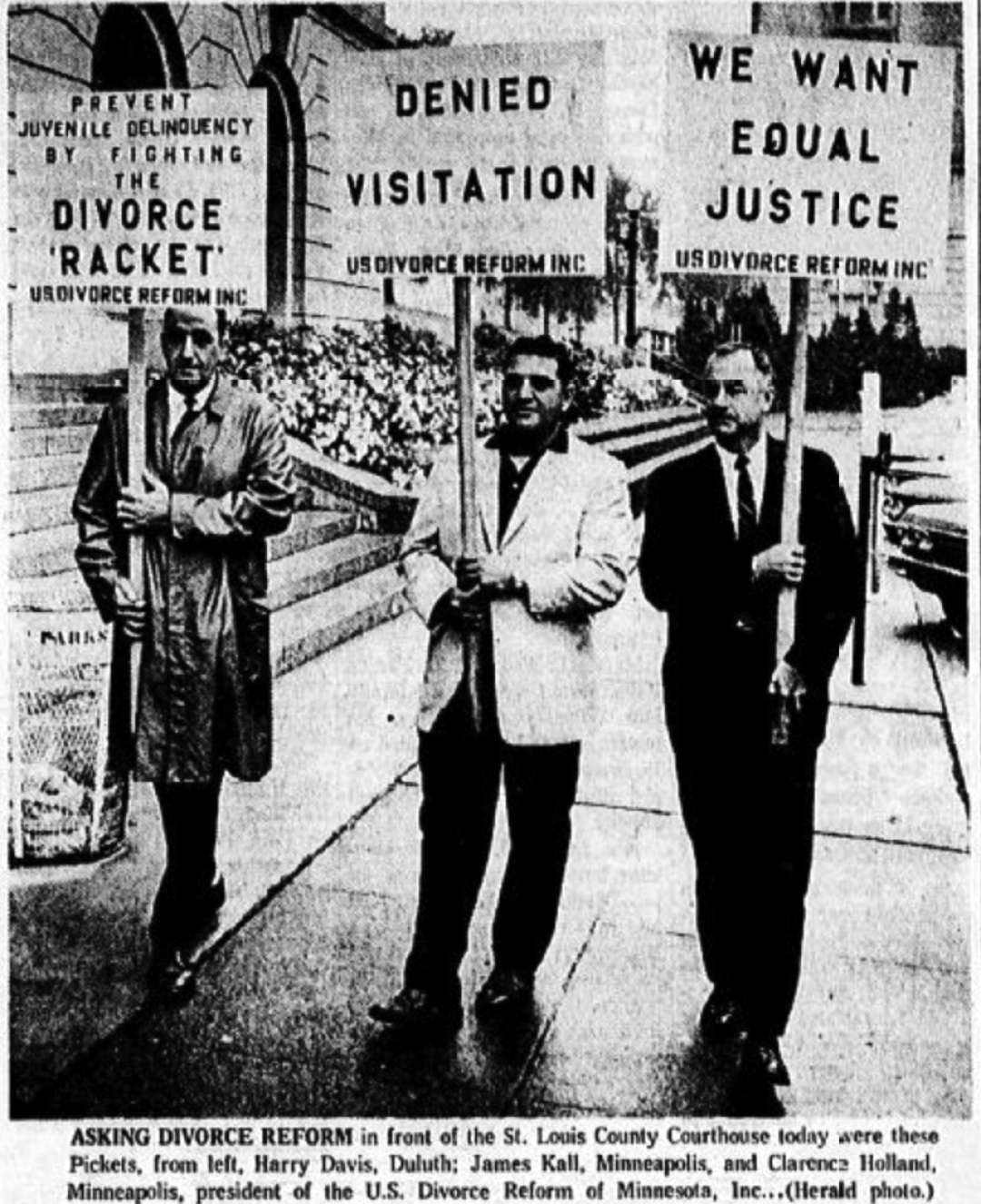
Divorce reform was the plea of three persons picketing the St. Louis County Courthouse today.
Clarence Helland, Minneapolis, president of the U.S. Divorce Reform of Minnesota, Inc., spokesman of the pickets, said his organization is a pressure group attempting to reverse some of the divorce laws “which give women all the benefits.”
Helland said the organization had its first meeting in Duluth Sunday with 40 persons in attendance.
“We will have regular meetings now at the Duluth Labor Temple the second and
fourth Sunday of each month,” he said.
Helland spoke of what he called the “Minnesota Divorce Racket.”
He said that as soon as a woman files for divorce, or even if a man files, the courts make the man move out of the house regardless of who the offended party actually is.
“If the case is contested, we may have to stay our of our homes for from one to five years and allow the former wife and her ‘friends’ to occupy it.
In Minnesota, he said, the man pays, right or wrong. Win or lose, he must, rightly pay his own attorney fees, his wife’s attorney fees and, in many cases, alimony and child support.
Major reform proposals of the organization, Helland said, are to abolish alimony, provide the father with equal custodial rights, provide by law that all attorneys’ fees shall be paid by the party contracting for them, and that divorce actions be heard by district court judges with a minimum bench background of five years.
Helland said not all members of his organization are men. Many are second wives who also suffer from the present divorce laws, he said.