Gems of Lake Superior
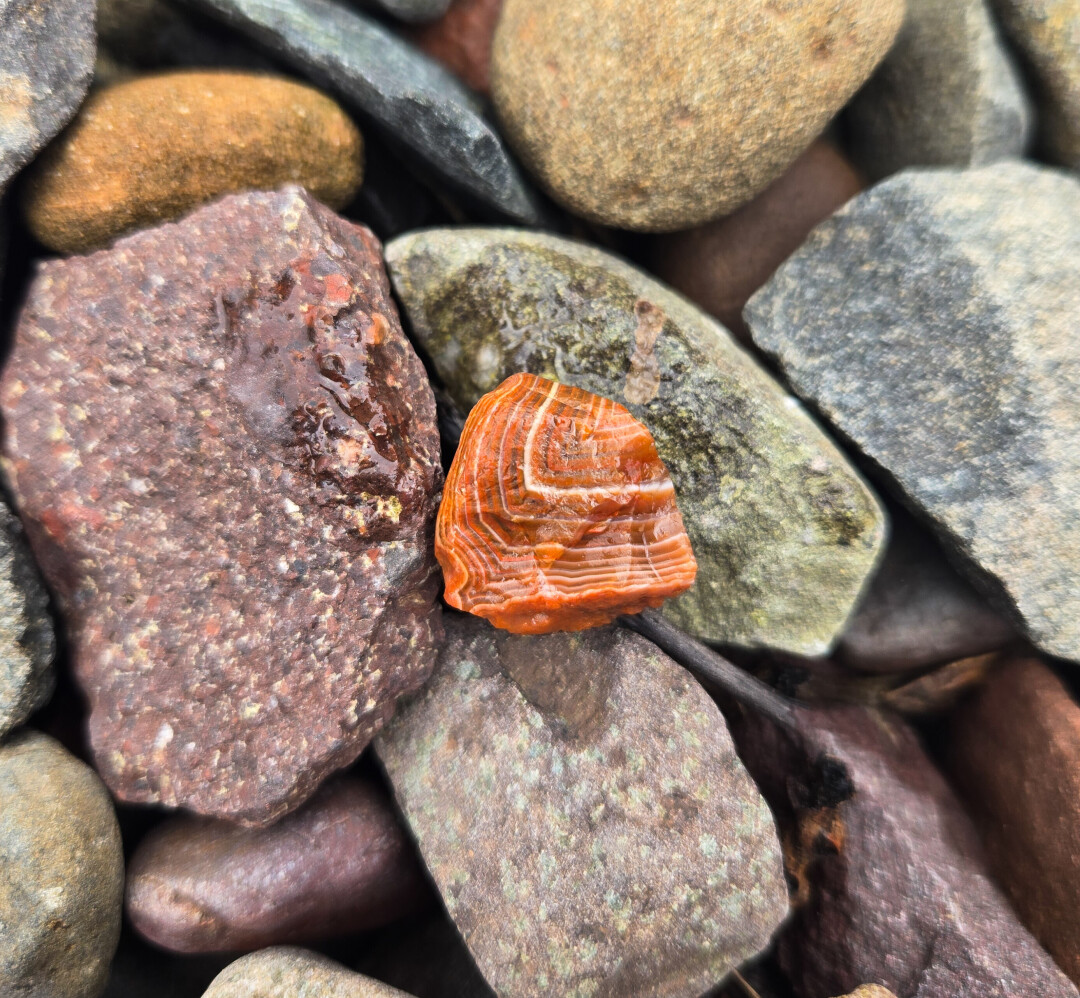
My hands moved slowly over the pebbled beach as the waves of Lake Superior gently lapped the shoreline.
I had found myself a nice spot to sit on the beach, close enough to the waterline to gaze at the rocks being gently tumbled by the waves, but far enough back to have a dry place to sit.
As I surveyed the pebbles around me, I spotted what I was looking for. The waxy, red-banded surface of an agate poked out from the shore, beckoning me to pick it up. And though I had found the treasure I was seeking, I was determined to find more during my time along the beach.
These beautiful Lake Superior gemstones are a fascination for many people, with their different patterns and stunning hues of reds, oranges and yellows. But their impressive looks aren’t the only enticing thing about them.
These agates have an incredible formation story that starts a billion years ago when the ancient continent Laurentia, that would eventually become part of North America, began to tear itself apart.
Basaltic lava flows erupted from Earth’s crust on a massive scale, spreading out across the landscape. These iron rich lava flows eventually cooled, creating the low basin full of volcanic rock that would eventually become Lake Superior.
These ancient lava-formed rocks were the birthplace of Lake Superior agate. Inside the hardened lava were many gas pockets, called vesicles. These vesicles are formed by the sudden release in pressure as the molten rock bursts from the earth’s surface. This pressure release causes dissolved gasses to form bubbles within the lava.
As the lava cools, the gas bubbles harden in place. Groundwater carrying silica, iron and other dissolved minerals seeped through the volcanic rock and into the vesicles. As the water evaporated, a microcrystal rind consisting of fine particles of quartz formed in the hollow area.
Over time, as the environment changed, so did the minerals seeping in, creating different colors of crystalline bands. The process of adding colorful bands continues until the vesicle is full.
And in the volcanic bedrock of the Lake Superior Basin the agates sat, until the last ice age when glaciers busted them out.
During the last glacial maximum, the Laurentide Ice Sheet covered most of Canada and a large portion of the northern U.S., including the Lake Superior basin. The glaciers scraped and eroded the basin as they repeatedly grew and receded over the last ice age. This glacial movement eroded the basalt bedrock, exposing the agates inside.
The glaciers acted like a giant rock tumbler that fractured, roughly polished and distributed agates along the landscape. Because of glacial movement, Lakes Superior agates can be found in many midwestern states.
While I have always loved finding agates and observing the many different patterns that they can possess, I now can appreciate the process that formed each Lake Superior agate that I come across.
These gems were a billion years in the making. Forming in the ancient lava flows of the Mid-continental Rift, as ground water slowly percolated into the vesicles, forming the agates bands over millions of years. Until finally, the agates were freed and distributed by the glaciers.
The agates we find today have had quite the journey. It is incredible to me that we can hold such a beautiful and ancient part of our geological past right in our hands. What a special treasure.
Heaven Walker is Educator/Naturalist at the Cable Natural History Museum. . For more than 50 years, the Cable Natural History Museum has served to connect you to the Northwoods. Our Summer Calendar is open for registration! The Museum’s new exhibit, The Wetland Way is now open! Discover how life thrives at the intersection of soil and water. Follow us on Facebook, Instagram, YouTube, and cablemuseum.org to see what we are up to.