This week in history
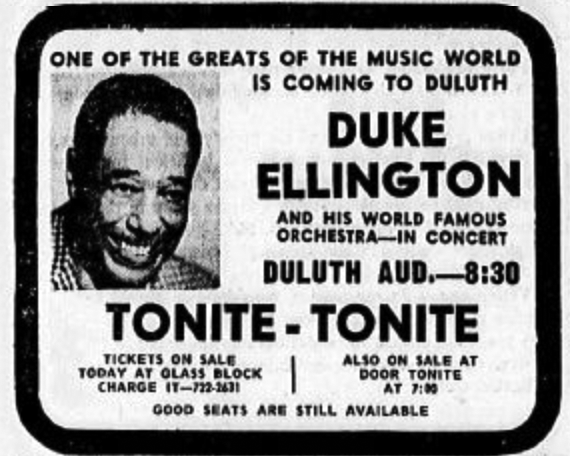 Duluth Herald, Sept. 6, 1966.
Duluth Herald
Aug. 27, 1888
MARRIED WHILE SICK.
Probably the most romantic marriage that ever occurred in Duluth took place at the residence of Dr. Cathill, No. 210 Third avenue east, last night, the Rev. Dr. Findley, of the Second Presbyterian church, officiating. The contracting parties were Dr. Taylor, a West Duluth physician, a partner of Dr. Geo. W. Davis., and Miss Maggie Hill, a pretty and aristocratic Philadelphia girl. Only a few personal friends witnessed the ceremony. About three weeks ago, Dr. Taylor was taken suddenly ill from typhoid fever and for a long time was dangerously sick. From the beginning of his illness telegrams daily carried to Philadelphia the news of his condition to his alarmed parents, and anxious betrothed, Miss Hill. As he did not seem to be recovering from the fever’s attack with the desired rapidity it was decided that Miss Hill should come to Duluth to nurse him. This she did and arrived in Duluth last Monday. Since then she has only left the patient’s room at St. Mary’s hospital to eat and take much needed rest. Under her loving care the sick man slowly convalesced. The couple were to have been married in September, but as the doctor’s illness was liable to prove of long duration, and thinking perhaps that a wife could do more for his recovery than a mere nurse, although love did hallow her labor, it was mutually agreed that the marriage should take place at once. So Saturday morning the doctor was removed to Dr. Cathill’s, and there, too weak to stand, he was made husband of one of the most charming brides a Duluth sun ever shone on. The couple certainly deserve happiness that a long life can bring.
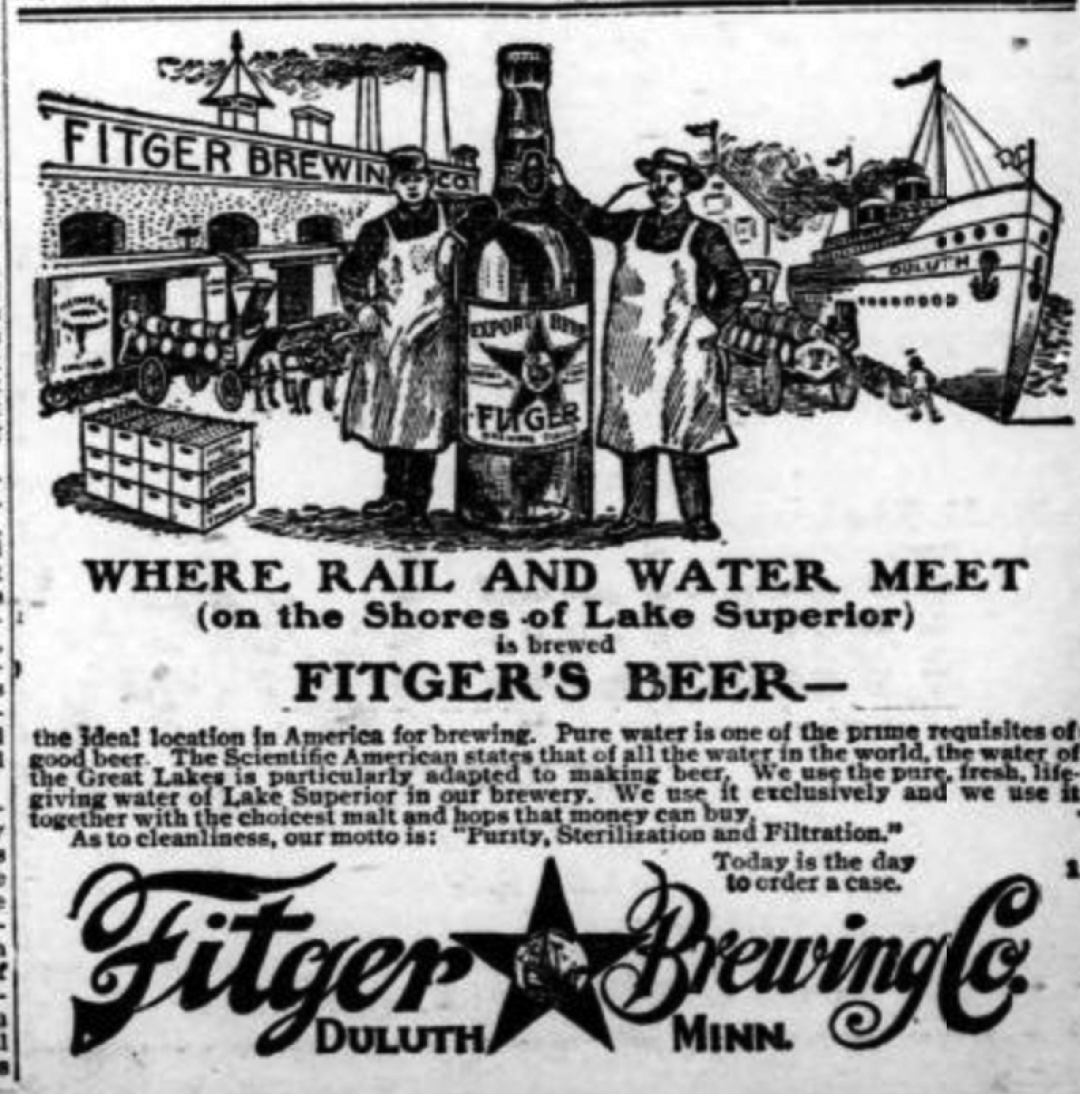 Duluth Herald, Aug. 29, 1906.
Duluth Herald
Aug. 28, 1896
LYCEUM ORCHESTRA.
City Band Will Furnish
Music This Season.
The matter of furnishing music for the Lyceum theater this year has been settled, and a contract has been signed by which ten of the best members of the City band will form the orchestra the coming season. J. H. Flaaten will be the leader, and they hope to furnish music this season which will be far superior to that of any previous season.
The instrumentation will be as follows: Gus Flaaten, second violin; I. Sodahl, viola; E. Lieweld, bass; Al Kretschmar, flute; Ernest Meier, clarinet; L. Mostad, first cornet; J. Young, second cornet; George Huse, trombone; C. W. Benson, drums.
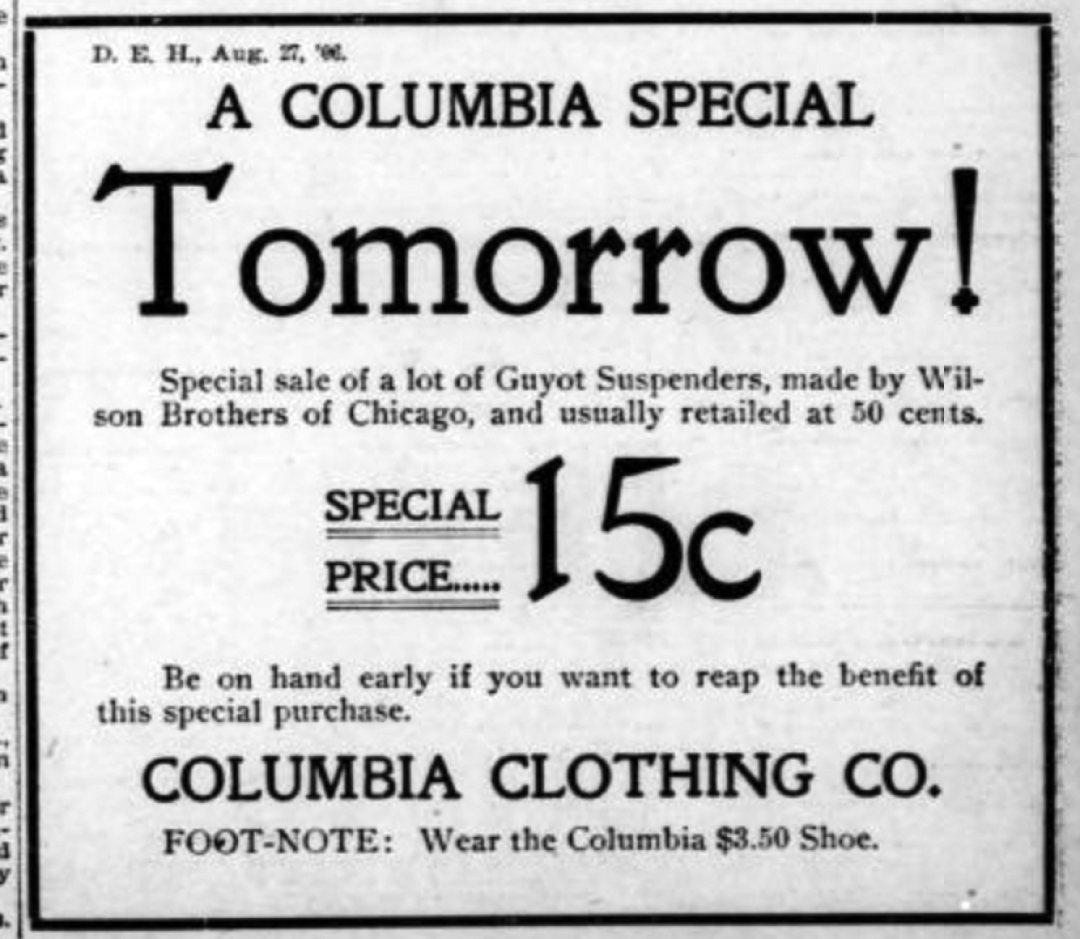 Duluth Herald, Aug. 29, 1906.
Duluth Herald
Aug. 29, 1906
REFORMED SPELLING.
Will Be Adopted By Silberstein
& Bondy Company.
The Silberstein & Bondy company of this city has announced that hereafter it will use the reform method of spelling in writing advertisements. This firm has always been in the foreground in presenting new ideas in modern merchandising, and this step toward simplifying the English language is in keeping with this policy in advancement.
In speaking of the change, E. A. Silberstein says that it is universally admitted that our intricate language places a direct burden upon every user of English and wastes a large part of the time given to the instruction of children, keeping them a couple of years behind those of Germany. Mr. Silberstein said that every native user of English believes that if it is not unfairly handicapped the English language will in time become the dominant and international language of the world. The Silberstein Bond company intends to do all it can to assist in the work, and hereafter the reformed spelling will be adopted in all of its advertisements.
Editor’s note: The reform spelling movement was popular in the late 19th and early 20th centuries. It encompasses any of several methods of spelling English words that use letters with more phonetic consistency than conventional spelling and that usually discard some silent letters (as in pedagog for pedagogue).
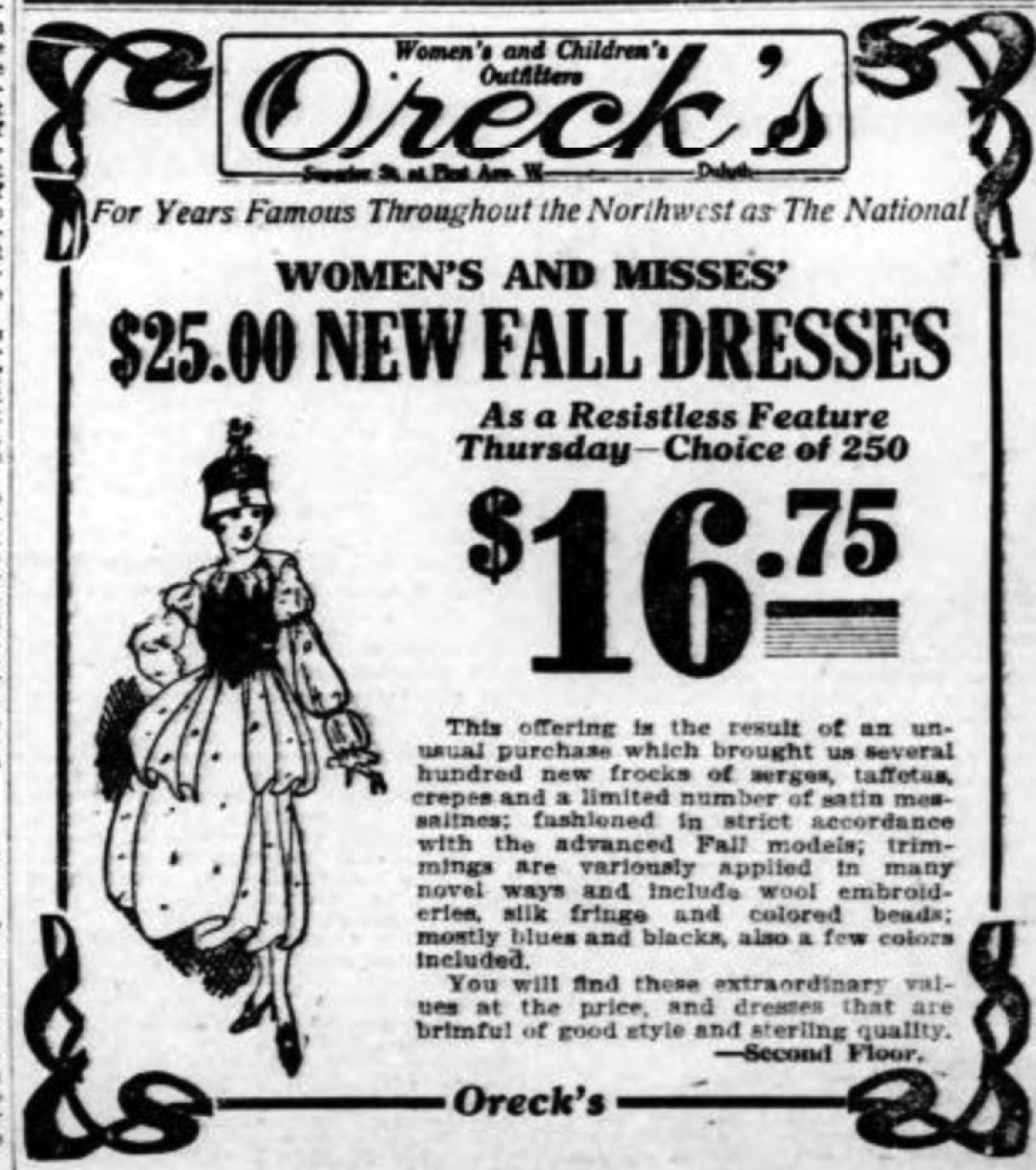 Duluth Herald, Aug. 30, 1916.
Duluth Herald
Aug. 30, 1916
AROUSES INTEREST
IN INDIAN FAIR
Fond du Lac Agent Cross Hopes
to Make Show Success.
Cloquet, Minn. – Indian Agent G. W. Cross hopes to make the third annual Indian fair a success. The fair will be held on Thursday, Friday and Saturday, Sept. 21, 22 and 23, at the Cloquet baseball park.
The purpose of these fairs is to arouse the Indians to the realization that they can produce an income on their allotment by converting them into productive farms.
During this fair experts on agriculture, stock and poultry will be secured to address the Indians and to give them pointers on stock raising, dairying and gardening.
Urges Saving Samples.
Agent Cross and others are urging the Indians and the whites to save their samples of farm goods for the Barnum fair and the Cloquet Farmers’ day as well as for the Indian fair, which will be held at Barnum.
Mr. Cross had arranged a program for the Indians to show their athletic ability, and a baseball game has been arranged.
It has been suggested that the Farmers’ day and the Indian fair be held at the same time, and if arrangements can be made for it, it is certain to be a success.
 Duluth Herald, Aug. 30, 1916.
Duluth Herald
Aug. 31, 1926
HAY FEVER GROUP
TALKS ELECTION
Missouri Banker considered
for Presidency of Association.
With the annual business convention of the Interstate Hay Fever association scheduled for tomorrow afternoon at the Hotel Duluth, friends of Edward J. Thorne, prominent Missouri banker, started a movement this morning in behalf of his candidacy for the presidency of the organization.
Fred Sears of Duluth, president of the association, announced last night that he would not be a candidate for re-election because of pressure of business, and the campaign for Mr. Thorne was begun this morning.
Mr. Sears spent considerable time during the last year in advertising Duluth as a hay fever center throughout the country.
“The foundation has been laid to make this city the national mecca for hay fever visitors and I feel that the work should be carried on by the association and the Chamber of Commerce,” said Mr. Sears this morning.
Mr. Sears estimated that there are from 400 to 500 hay fever visitors in Duluth and that the convention this year is the largest in the history of the organization.
The annual banquet will take place at 6:30 p.m. Thursday, with Homer Fulton, Duluth attorney, as the principal speaker.
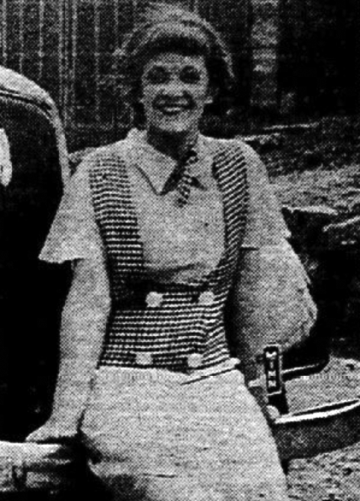 Mrs. Gustafson
Duluth Herald
Sept. 1, 1936
June Bride Killed as Auto Hurtles Down Hill As September Safety
Drive Gets Under Way
Sudden death accepted the challenge of Minnesota safety leaders today and claimed the lives of two Duluthians, one a bride of only a few months. Three others escaped with minor injuries. Dead are:
Mrs. Rudolph Gustafson, 20, 15 South Ninety-third avenue west.
Fred Sunderland, 47, proprietor of the Florida Orange store, 20 East Superior street.
Injured were Mrs. James Mark, mother of Mrs. Gustafson, and Sarah Mark, 18, and Drusila Mark, 11, sisters of the victim.
The man and woman were dead shortly after the “Let’s Make September the Safest Month” campaign got under way in Duluth and the state.

LOSES CONTROL OF CAR.
The June bride was killed and her mother and two sisters injured when Mrs. Gustafson, driving, lost control of the car as she started driving it away from the house a few minutes before 8 a.m. today. The house is located on a hill just above Grand avenue.
The car wheels caught when Mrs. Gustafson was unable to swing the vehicle back in line. The crowded condition of the front seat of the coupe made it difficult for the driver to manage the car, authorities said. Mrs. Gustafson was crushed by the driver’s wheel as the car rolled over three times finally coming to a stop in Grand avenue.
Elmer Johnson, 434 North Fifty-seventh avenue west, and Willard Peterson, 4715 West Michigan street, on heir way to work at the American Steel & Wire Co. in Morgan Park, took the victim to the Weber hospital, but she was dead when they arrived.
STRUCK BY TWO CARS.
Sunderland was killed almost instantly when hit by two automobiles in Michigan street at Twelfth avenue west at 12:30 a.m.
Claude Kreiling, 31, 521 East Tenth street, is being held by police on an open charge. He remained at the scene of the mishap. Authorities today are seeking the driver of the second car which figured in this accident.
Kreiling told police that he was driving easterly in Michigan street when the mishap occurred. He stopped when he realized he had hit the man. The second vehicle meanwhile, going westerly, struck Sunderland again. Police believe the man suffered fatal injuries as a result of the second impact. He was dead upon arrival at St. Mary’s hospital.
The deaths brought the city’s toll to 18 since Jan. 1, two more than the entire number killed during 1935.
 Duluth Herald, Sept.. 1, 1936.
Duluth Herald
Sept. 3, 1946
Reds, Klan in Federal Jobs Are Lashed
Civil Service Commissioner Arthur S. Fleming called on federal workers today to devise their own code of ethics to preserve public confidence in government.
At the same time, Fleming reiterated that Communists and Ku Klux Klan members cannot be tolerated in federal jobs, nor persons who believe that government workers should have the right to strike.
In a speech delivered at the National Federation of Federal Employes convention in Cleveland, the civil service chief declared that “recent developments have shown that there are some spots in this government where we are in need of either a written or unwritten code of ethics.”
Without specifying what developments he had in mind, Fleming said they “shake the confidence of the public in their government,” adding: “The most effective steps are those which members of the career civil service can take themselves. They can develop a written or unwritten code of ethics.” Fleming said that members of the Communist party and those who follow the party line “have demonstrated that their thinking and their actions have in the past been controlled by a foreign political group.”
“The duties of public office cannot, therefore, be entrusted to them,” he continued.
“By the same token, members of the Ku Klux Klan, or members of any other organization that espouses the Nazi or Fascist way of life, have no business working for government.”
Noting that federal salaries have been raised an average of 33 per cent during the last two years, Fleming said it should not be assumed that those increases “are the last word.”
“The least that the government as an employer can do,” he added is to make sure that in 1946 its employes are able to purchase the same necessities of life they were able to purchase with their 1941 earnings.”
He said studies are under way for an “overall revision” of the government salary structure.
 Duluth Herald, Sept. 4, 1956.
Duluth Herald
Sept. 4, 1956
Bridge
Rated
Sufficient
Engineers Say That Bars
Only Occasional Ship
The engineering firm hired by the states of Minnesota and Wisconsin said today that a 100-foot vertical clearance of the Duluth-Superior high bridge is sufficient except for a “very occasional” vessel which may visit the Twin Ports after completion of the St. Lawrence Seaway.
In a report sent to Mayor Eugene R. Lambert by Gov. Orville L. Freeman, the firm of Howard, Needles, Tammen & Bergendorff said that the highest fixed point above water line at light draft of 86 per cent of the U.S. merchant fleet was 110 feet or less as of Jan. 1, 1953.
“Loaded or in ballast, the tallest of these vessels could readily pass 100 feet of vertical clearance,” the engineering firm said.
Lambert said that Robert T. Smith, Duluth port director, is preparing a reply to the report. The report, Lambert pointed out, does not include foreign vessels which officials hope to attract to the Head of the Lakes when the seaway is completed.
The proposed high bridge has been planned at a height of 100 feet. But the Duluth and Superior port authorities have recommended a height of no less than 125 feet so the bridge would not bar some ships from entering the inner harbor.
Freeman said he was sending the report to Lambert and the Duluth port authority for their comments.
The report seems to indicate that a complete study hasn’t been made, Lambert said.
“Ample docking facilities can be made in the outer harbor,” the engineering firm wrote, “for the occasional vessel of extraordinary height or, if it should become necessary that certain of these be taken into the inner harbor, their masts could be lowered at no great cost.”
It would appear to be more in the public interest, they added, to require modification of an “occasional” vessel rather than force the 4,200,000 vehicles expected to cross the bridge each year to climb a steeper grade at “increased hazard and cost.”
(Editor’s note: The Blatnik Bridge rises 120 feet above the water.)
 Duluth Herald, Sept. 6, 1966.
Duluth Herald
Sept. 6, 1966
Litchfield Firm Low On
Freeway Portion
Apparent low bidder on construction of the first major portion of Interstate Highway 35 (the Freeway) in Duluth was Johnson Brothers Construction co., of Litchfield, with a bid of $5.6 million.
Bids are being studied and a contract will be awarded this week. Construction is scheduled to start in two weeks.
Johnson Brothers was low bidder and carried out construction of Duluth’s Fifth Avenue West overpass, part of the Highway 35 system.
Its new bid covers construction of the four-lane freeway from 41st Avenue West to 25th Avenue West. The job will take about two years. This portion of the highway will run along the bayfront. It will start south of Oneota and Jenswold Streets at 41st Avenue West, then run under the ore docks at 34th Avenue West, over the nearby North Pacific and Duluth, Missabe & Iron Range Railway tracks and through the southern portion of West Michigan Street Urban Renewal District to 25th Avenue West.
This portion of the highway will contain two bridges, one over the Soo Line Railway tracks at Oneota and Jenswold Streets and another over the Northern Pacific and DM&IR tracks east of the ore docks. There will also be an overpass above the Freeway at 40th Avenue West.
Work is scheduled to start next spring on connecting the stretch of the Freeway from 41st Avenue West to the section being built at Thompson Hill. Construction in downtown Duluth will start in the fall of 1967. The entire Freeway from the Twin Cities to 12th Avenue East in Duluth will be completed in 1972.