Commander and company rip it up in debut record
Welcome to this new feature, and the Reader welcomes you to tell us what you think is a great debut record and why.
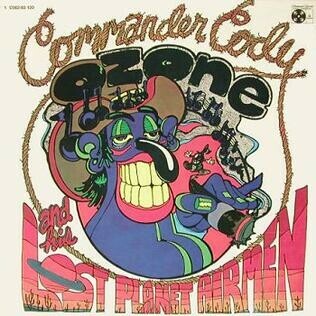
We’re going to start it off with Lost In the Ozone by Commander Cody and His Lost Planet Airmen.
Released in November 1971, the album spawned a 1972 hit in a cover of Charlie Ryan’s 1955 rockabilly song “Hot Rod Lincoln,” the only song on the record where the Commander sings lead, due, he later said, to his ability to talk fast.
Country rock was all the rage at the time – The Eagles, Poco, Marshall Tucker, Pure Prairie League –but Commander and crew were in a class all their own, with a giant sense of humor about what they were doing and such an embrace of the counter-culture that it made other bands seem like squares.
The Commander’s real name was George Frayne. I once read an interview where Frayne said he came up with the band name after watching a Republic serial with that title. Yes, there were two Republic COMMANDO Cody serials – the 1952 Radar Men from the Moon (which was mercilessly lampooned by the MST3K crew in its first season) and Sky Marshal of the Universe (1953).
Lost Planet Airmen was a 1951 theatrical release, compiled from the 1949 12-part Republic serial King of the Rocketmen, and had nothing to do with the Commando Cody serials.
I believe the reason for the confusion is that the flying suit worn by lead character Jeff King in the 1949 King of the Rocketmen was recycled and worn by the hero of the two later Commando Cody serials.
No matter the origin story, it’s a great band name.
The band formed in Ann Arbor, Mich., in 1967, where Frayne earned both an undergrad degree in design and a master’s degree in sculpture and painting at the University of Michigan, graduating in 1968. He served for a short time on the art faculty at the University of Wisconsin-Oshkosh.
Frayne’s brother Chris was also an artist who designed most of the band’s album covers, including the goofy Lost In the Ozone cover. Many of his later covers played on the sci-fi nature of the band’s name.
In the same interview referenced above, Frayne said he discovered marijuana and Bob Wills at the same time,which is what got him and the other guys in the band to buck the psychedelia trend and dig into American roots music – country, boogie-woogie and rockabilly, all three of which are evident on the band’s great debut record, Lost in the Ozone.
In addition to Frayne as the Commander of the keyboard, the band included Frayne’s songwriting partner Billy C. Farlow, lead singer and harmonica; John Tichy, rhythm guitar and vocals; the great Bill Kirchen – “Titan of the Telecaster” – lead guitar; Andy Stein doing double duty on sax and fiddle; “Buffalo” Bruce Barlow, bass; Lance Dickerson, drums; Steve “The West Virginia Creeper” Davis, pedal steel guitar.
The album kicks off with the Commander demonstrating his mastery of boogie-woogie piano in the country-tinged rocker “Back to Tennessee,” and representing the first of three great Farlow-Frayne songwriting collaborations. Three others songs were by Farlow alone, and the remaining half-dozen songs are covers, including the album’s hit “Hot Rod Lincoln.”
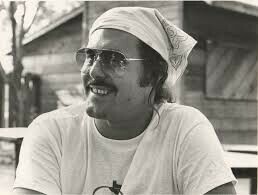 George "Commander Cody" Frayne
The Farlow-Frayne combination of songs open the album. Their second song is pure country, “Wine Do Yer Stuff,” with the West Virginia Creeper’s pedal steel guitar doing its stuff to great effect
But it’s the next song by the duo that first blew my mind those many years ago. It just might be the greatest country song ever written – “Down to Seeds and Stems Again.”
“It starts off with the Commander’s piano plinking, followed by the weeping pedal steel and Andy Stein’s somber fiddle. It goes like this:
I’m sittin alone, Saturday night, watching the Late Late Show
A bottle of wine, some cigarettes, I got no place to go
Well, I saw your other man today,
he was wearing my brand new shoes
And I’m down to seeds and stems again, too
Well, I met my old friend Bob today from up in Bowling Green
He had the prettiest little gal that I’d ever seen
But I couldn’t hide my tears at all ‘cause she looked just like you
And I’m down to seeds and stems again, too
Now everybody tells me there’s other ways to get high
They don’t seem to understand, I’m too far gone to try
Now these lonely memories, they’re all I can’t lose
And I’m down to seeds and stems again, too
Well, my dog died just yesterday and left me all alone
The finance company dropped by today and repossessed my home
That’s just a drop in the bucket compared to losing you
And I’m down to seeds and stems again, too
Got the down to seeds and stems again blues”
So very, very sad, especially the part about seeing the new boyfriend in brand-new shoes, and, of course, being down to seeds and stems again, too. I once knew that feeling. Thank god for sinsemilla.
“Down to Seeds and Stems Again” remained one of the most popular songs in the band’s legendarily long and raucous shows. Just to give an example of what a live show is like, the last three tunes on the debut album are taken from live shows – Farlow’s great “What’s the Matter Now,” “Twenty Flight Rock” and “Beat Me Daddy Eight to the Bar.”
In the next five years, the band recorded six more albums, ending the string in 1976 with the double live We’ve Got a Live One Here, recorded at several shows in London (damn, I was living in England in 1976 – wish I had been at those Commander Cody shows).
Frayne immediately formed the New Commander Cody Band and continued touring under various related names and with different lineups until shortly before his death at age 77 in September 2021.
Bill Kirchen continues touring and is recognized as one of the world’s great guitar players.
Listeners of Prairie Home Companion may recall Andy Stein playing in Garrison Keillor’s band for years, but he is also well known as a classical violinist/composer and arranger, and has recorded with the likes of Itzhak Perlman and Placido Domingo.
Rhythm guitarist John Tichy, who earned a Ph.D. from the University of Michigan, became head of the Department of Mechanical, Aerospace and Nuclear Engineering at Rensselaer Polytechnic Institute (RPI) in Troy, New York. Tichy has been a faculty member of that institution since 1976. The Reader has requested an interview with Professor Tichy about those days. Stay tuned!