An art show that asks Duluth to look and listen
Gender Joy Art Show at Zeitgeist

Included in the Gender Joy Arrt Show, “She Tweets,” by the late Leah Yellowbird, 1965-2025, depicting “A harmony of birds singing the feminine divine.” Acrylic and wood board on canvas, 36 x 24. Not for sale. Photos of art work and participants by Laura Marland.
“It’s all about the feminine divine and colorful pieces to bring joy into this kind of sideways world,” independent gallery curator Avery Makesroomforthem, who curated and hung the Gender Joy Art Show at Duluth’s Zeitgeist Arts Building, 222 E. Superior Street, explained at the show’s opening reception on May 7.
Humans have long told the world who they are through art. Now in its third year, the Gender Joy Art Show, running through June 27, makes that truth vivid and communal.
Organized by YWCA Duluth and Program of Aid to Victims of Sexual Violence (PAVSA), this year’s show gathers artwork from girls, women and gender-expansive people, the result of Makesroom’s unjuried call for work by local artists
Also on display are artworks by survivors of domestic violence, some signed “Anonymous,” to protect the identity of creators, produced by PAVSA clients in a weekly art group sponsored by the organization.
According to a LinkedIn article by the YWCA, Makesroom’s “approach gravitates toward bold, boundary-pushing works that challenge convention and spark dialogue.”
Adding to the collective feeling was a work conceived by Rachel Gilbertson, founder of Art of Presence. The work, “The Elephant in the Room,” began with attendees at the reception writing gendered insults, accusations and limitations that have been leveled at them due to their gender.
Gilbertson added color and will paint a picture of an elephant over the collection of words and then bring it back to the show.
This is a show that asks Duluth to look and to listen to questions about our construction of gender and our attitudes toward it. Works by 37 artists are on display, many available for purchase.
Following are comments from three of the artists.
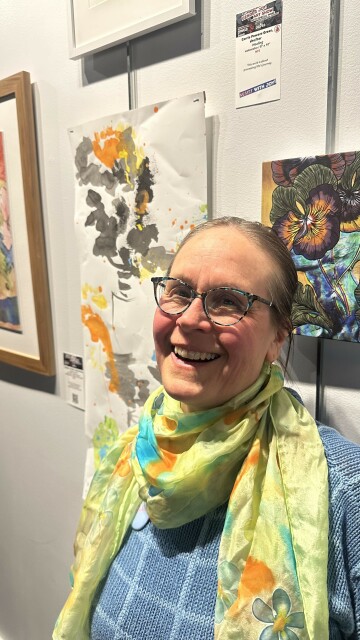
Lisa Fitzpatrick
Show contributor Lisa Fitzpatrick is a retired futurist, who worked as a Faculty Fellow at UMD’s Motion and Media Across Disciplines Lab, where she assisted professors in using and teaching such forward-looking technologies as augmented reality equipment designed to help nurses treating people who speak a foreign language.
Lisa has several degrees and she’s used to creating outside of the box.
She describes herself as “kind of an experimental person.” She responded to the call for artworks by thinking about the two concepts of gender and joy. “I thought about the concepts of gender joy and about the body.”
Wanting to bring the concepts of joy and the body together, she decided to dance with paint.
To create her submission to the show, she experimented with a Japanese ash paint, ultimately deciding to dip her bare feet in the paint and then dance on pieces of paper. Japanese ash paint technique has been linked to the concept of wabi-sabi because of its soft qualities, suggesting impermanence and imperfection.
Ultimately, she put on some music and danced in her unfinished basement, leaving prints of her feet on the paper. “It was pretty messy, but it was fun,” she says. Her message is “Let’s have joy.”
She commented after the reception, “I thought it was a wonderful experience. It was great seeing all the aspects of ways people expressed their gender and their joy. It felt so supportive and such a warm atmosphere.”
Heather N. Wilde
To create her contribution to the show, “Tapestry of Us,” Heather N. Wilde started with a quote by Maya Angelou, “We delight in the beauty of butterfly, rarely admitting the changes it has gone through to achieve that beauty.”
She sketched the quote boldly across the page. “Then I added some paper napkins. I kept turning and turning the painting so that I could figure out where I could draw a woman. One piece of napkin became a hat. One piece became a dress.”
The underlying quote merges with the bodies of women.
Wilde worked at Superior High School, teaching English to students who needed more support than they could get in a traditional classroom. She now directs much of her natural empathy toward working with authors through a publishing and author services company she founded, Hezzie Mae, which she describes as “a literary ecosystem where healing, advocacy, art and storytelling intersect.”
For example, she co-wrote and published the memoir, Floyd’s Baller, working with Adarryl Hunter, a friend of the late George Floyd, murdered by a Minneapolis police officer in 2020. The book focuses on their friendship and on life in their neighborhoods.
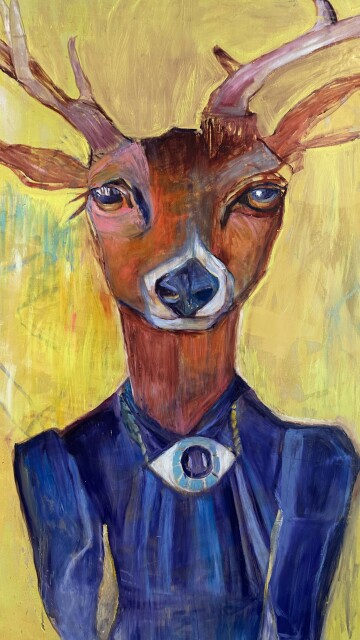
Knife River artist Patricia Canelake’s “Anthropomorphic Joy” – oil on canvas, 4’’5” x 6’5” – can be seen in the the Gender Joy Art Show at Duluth’s Zeitgeist Arts Building, 222 E. Superior St., through June 27.
Patricia Canelake
Patricia Canelake is an artist living and working in Knife River. Her painting’s evolution has taken off in the last five years. Figures have long taken prominence in her work — tightrope walkers or twirlers, a woman pulling a goat or horse.
Lately, she’s merging human and animal forms to create original images that speak to the viewer of our lives as humans and our relationships with animals. Her contribution to the show, a very large oil painting, is called “Anthropomorphic Joy.”
It’s a picture of a doe with antlers, which, she points out, does happen in nature, though rarely. “The human part is in the animal in that they are wearing clothes.” Her deer is also staring directly at the viewer — which deer don’t often do in the wild. That gaze seems very human.
“The human part is in the animal in that they’re wearing clothes.” In addition, she points out, “A deer isn’t going to stare at people that much.” The idea of a “gaze” is important, in part because we don’t stop to consider how animals see us.
Canelake’s partner, Frank Sander from Hamburg, Germany, is a documentary filmmaker, and she taught film, digital design and documentary filmmaking. She is represented by multiple Minnesota galleries, including Lizzards Art Gallery, 11 W. Superior Street, Duluth.
Many of her paintings explore the human-animal connection through the idea of a leash — of being tethered or untethered, as she puts it.
Her paintings are massive, though she is petite. “I’m five feet tall. I stand on a stool and also paint vertically. Against the wall. The studio is an old garage. I paint them on an easel or I paint them against the wall. As I line them up, they have to visually connect with each other as a body of work. They refer to each other.”
Constructing new individual works as part of a larger body of work is important to her, as it is to many artists, who need to show continuity and development in their style, rather than just jumping from one subject, style or theme to another.
“But it’s also kind of a fantasy. Artistic license. You can do what you want with it,” she added.